
Quick Answer: The Best Washer Pedestals are approved for the exact appliance, support every leveling foot, handle dynamic spin loads, preserve hose and cabinet clearance, and stand level on a structurally suitable floor. The WBD 12-inch all-steel pedestal is the most flexible single-appliance option in this group because its verified listing adjusts from 21 to 29 inches in width and depth and includes top and bottom pads. Choose the Royxen 20-inch model for a pull-out basket shelf, the GDLF 58.1-inch platform for a side-by-side pair, the GDLF 29-inch model for a listed drain pan, or the seven-foot adjustable frame for a wider two-appliance setup.



Top Picks at a Glance
These Best Washer Pedestals cover an adjustable single stand, a tall basket-shelf pedestal, a full-width side-by-side platform, an integrated-drain-pan design, and an adjustable multi-foot frame. Capacity, compatibility, vibration, assembly, ergonomics, drainage, durability, and code statements are manufacturer listing claims rather than independent structural or appliance tests.
- Best Overall Adjustable Stand: WBD Heavy-Duty All-Steel Laundry Pedestal, 12 Inches – a four-foot stand listed with 21-to-29-inch width and depth adjustment, scale markings, lock knobs, and anti-slip pads.
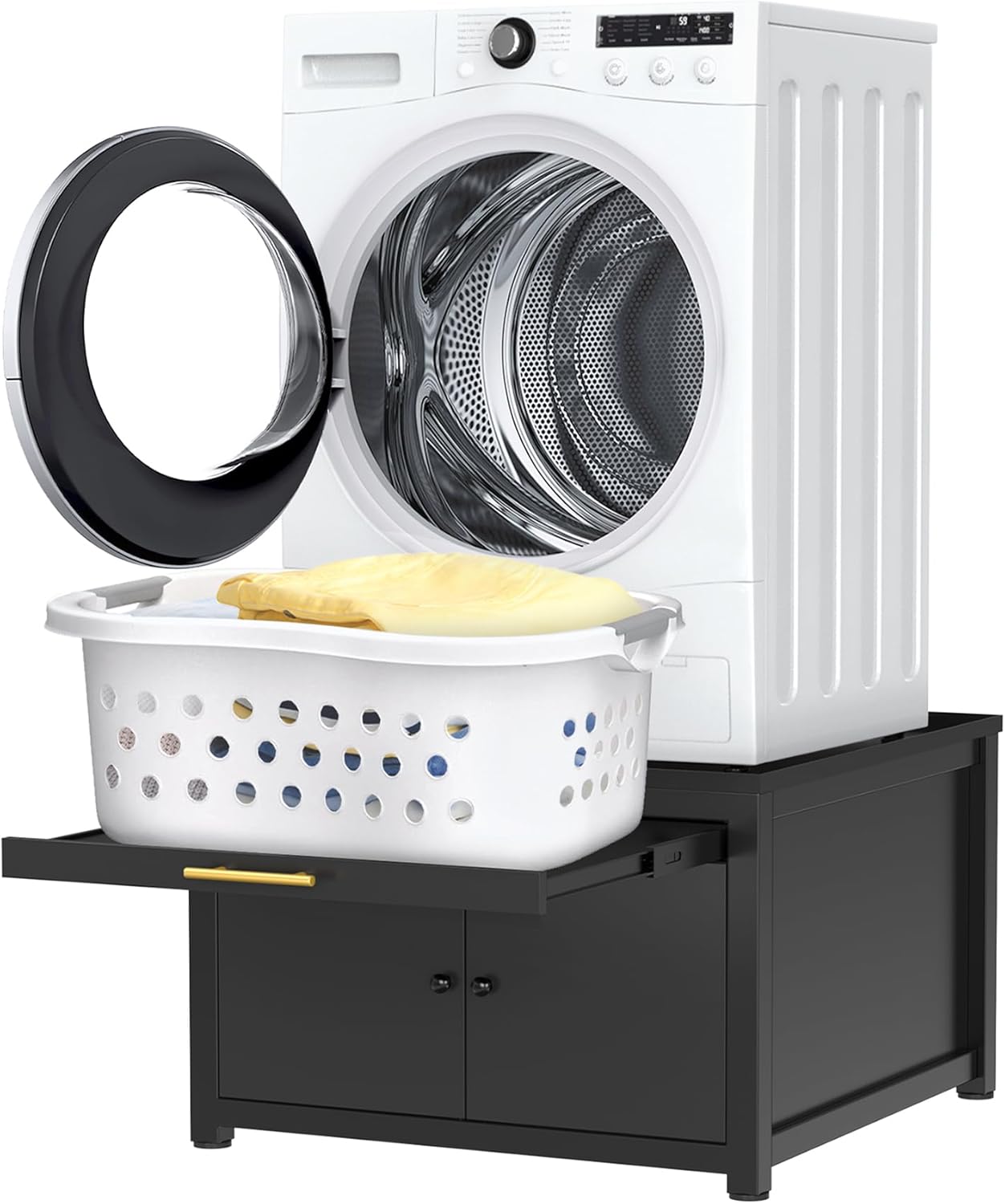
- Best Tall Basket Shelf: Royxen Washer and Dryer Pedestal, 29 x 29 x 20 Inches – a fixed-size steel pedestal with a sliding laundry-basket holder.
- Best Side-by-Side Platform: GDLF Washer and Dryer Pedestal, 58.1 Inches Wide – a full-width platform with a center pull-out shelf, drawer, and open basket compartments.
- Best with Drain Pan: GDLF 29-Inch Laundry Pedestal with Storage and Drain Pan – a 19.6-inch-high single-appliance stand with basket shelf, drainage tube, and anti-vibration pads.
- Best Adjustable Double Frame: Adjustable Washer Dryer Pedestal, 40.9 to 66.14 Inches Long – an open frame listed with seven support feet and optional center support for larger machines.
OEM and Universal Pedestals Are Different
An OEM pedestal is designed for specified washer or dryer models and may bolt into dedicated cabinet points. Those attachments, foot locations, drawer clearances, and anti-tip provisions form part of the appliance installation.
A universal pedestal usually supports the appliance by its leveling feet or cabinet base without model-specific fasteners. A matching footprint does not prove that the washer maker permits that support method, especially for a high-speed front-loader or stacked pair.
The Best Washer Pedestals begin with the appliance installation manual. If the manufacturer requires a named pedestal, base, bracket, or stacking arrangement, a marketplace universal-fit claim does not override that requirement.
How to Choose the Best Washer Pedestals
Record the exact washer model, weight, footprint, foot locations, loading direction, door swing, service clearances, and installation type. Then compare those facts with the fully assembled pedestal, not only its advertised outer dimensions.
Distinguish Static Capacity from Spin Loads
A washer’s shipping or empty weight is not the entire load. Water, wet laundry, drum rotation, acceleration, and an imperfectly balanced load create changing forces. A static capacity statement does not by itself prove stability during maximum spin.
Ask whether the stand is intended for an operating washer, not merely a refrigerator, cabinet, or stationary appliance. Check how the top supports the actual feet and whether cross-braces and fasteners resist side-to-side motion.
The Best Washer Pedestals support the appliance under real operating conditions specified by both manufacturers. Never use a stand whose capacity, dynamic-load purpose, or required bracing is unclear.
Measure the Footprint and Foot Locations
Measure cabinet width and depth, then locate all leveling feet relative to the edges. Each foot must land fully on a designed support area, not on a seam, hollow shelf, drain lip, bolt head, or adjustable rail gap.
Adjustable models need enough overlap and every prescribed lock knob or cross member. The WBD listing covers a 21-to-29-inch range, while the multi-foot frame spans a much wider side-by-side arrangement. Use the instructions for center supports when the appliance size requires them.
The Best Washer Pedestals do not depend on plywood, bricks, spare rubber, or improvised plates to bridge a footprint mismatch. Modification can shift loads away from tested structural paths.
Choose Height by Access and Stability
A 12-inch stand reduces bending while keeping the center of gravity lower than a 20-inch pedestal. A taller design may improve front-door access and basket placement but increases total installation height and leverage during spin.
Measure shelves, counters, wall cabinets, utility hookups, detergent drawers, doors, controls, and the shortest user’s reach. A top-loader may become difficult to unload or may not open beneath a cabinet; one selected GDLF listing specifically does not recommend its tall pedestal for top-loading machines.
The Best Washer Pedestals improve access without creating an unreachable control panel, blocked detergent drawer, head-strike hazard, or unstable tall appliance.
Check Hoses, Drains, Vents, Power, and Gas
Raising or moving a washer changes the route and strain on inlet hoses, drain hose, and power cord. The drain standpipe height must still remain within the washer’s limits, and no connection should be stretched, pinched, coiled sharply, or rubbed against the pedestal.
A paired dryer adds exhaust-vent, electrical, or gas requirements. Do not extend or reroute a gas connector as a casual installation step. Qualified service may be required, and all vent clearances and local requirements remain applicable.
The Best Washer Pedestals leave safe service slack without letting hoses or cords contact moving shelves, sharp steel, hot dryer surfaces, or stored items.
Evaluate the Floor Structure
The floor carries the combined weight of pedestal, appliance, water, laundry, and any adjacent dryer. A stand transfers that load through four, seven, or more concentrated feet. Soft subfloor, loose tile, uneven grout, rot, slope, or excessive deflection can undermine an otherwise strong steel frame.
Large side-by-side platforms require a flat plane across their full width. If one corner is low, forcing the frame level can twist it or leave a foot unloaded. Obtain structural or installation advice when the floor bounces, cracks, or shows water damage.
The Best Washer Pedestals rest on firm, level, manufacturer-approved flooring. Anti-slip pads cannot repair a weak floor or distribute weight like an engineered structural upgrade.
Compare Storage Shelves and Drawers
A pull-out basket shelf can support laundry during transfer, while a drawer keeps small supplies out of sight. Verify the shelf load, extension clearance, stop mechanism, handle, and whether opening it changes stability.
Do not store children-accessible chemicals, aerosol cans, flammable products, or items that block ventilation and leak inspection. Keep liquids upright and away from dryer heat, electrical connections, and the path of a potential washer leak.
The best laundry pedestal drawers address storage-focused choices. The Best Washer Pedestals retain every required brace even when open space below looks useful for a basket.
Understand Drain-Pan Features
An integrated pan can catch a small leak only within its capacity and only when seams, drain fitting, hose, and termination are correctly installed. A drainage tube does not protect the floor if it is capped, routed uphill, kinked, or discharged to an unsuitable location.
Check whether the pan remains visible for inspection and whether appliance feet stay away from its edges. A major supply-hose failure can exceed a shallow pan faster than its drain handles water.
Compare dedicated laundry floor trays when containment is the priority. The Best Washer Pedestals do not substitute a listing’s drain-pan claim for proper plumbing, leak detection, and hose maintenance.
Stacked and Side-by-Side Installations
A stacked washer and dryer have a higher center of gravity and rely on a model-specific connection. Do not put a stacked pair on a universal pedestal unless the washer, dryer, stacking-kit, and pedestal manufacturers approve the complete combination.
The best washer stacking kits must still match both appliance models. A pedestal cannot replace brackets, anti-tip parts, or rear clearances.
Side-by-side full platforms align two appliances and offer storage, but both machines must fit their designed zones. Consider vibration interaction, dryer vent routing, different cabinet depths, door swings, and service access.
The Best Washer Pedestals preserve independent leveling and connection safety for each appliance, even when both share one broad frame.
Assemble the Empty Pedestal First
Inventory all frame rails, feet, braces, panels, fasteners, lock knobs, pads, shelf parts, and drain components. Do not substitute hardware or omit a support because the frame appears rigid before loading.
Assemble on a protected flat surface and follow the sequence, orientation, and tightening method. Adjustable frames should be squared by measuring diagonals when the instructions call for it. Tighten fasteners evenly so one corner is not pulled out of plane.
Level the empty stand at its final location and engage all feet. The Best Washer Pedestals do not rock before the appliance is added. A drawer or shelf should move without shifting the frame.
Transfer the Appliance Safely
Washers and dryers are heavy and can be top-heavy. Follow the appliance manual for shutdown, water draining, shipping supports, door security, and movement. Use trained helpers, an appliance dolly, lifting straps, or professional installers.
Never lift by the door, dispenser, control panel, hoses, cord, or sheet-metal edge. Never place hands or feet beneath an appliance held only by people. Gas dryers and stacked units require appropriate qualified handling.
Center the appliance exactly where the pedestal instructions specify and use all attachment or retention parts. The Best Washer Pedestals are not loaded by sliding an unprotected metal cabinet across the top until it catches a pad.
Level, Reconnect, and Test
Level the washer front to back and side to side after it is on the pedestal. Adjust the approved leveling legs, then tighten locknuts. Do not use independent anti-vibration pads unless both manufacturers permit the added layer; the best washer anti vibration pads solve a different fit problem.
Reconnect water, drain, power, vent, and gas by their manuals. Inspect behind and beneath the pedestal for crushed lines, sharp contact, leaks, and insufficient service loops.
Run the washer’s installation or calibration routine when required, then observe a balanced test load from a safe distance. Stop for rocking, frame movement, loose fasteners, unusual sound, leaking, hose strain, or contact with cabinetry.
The Best Washer Pedestals remain still while the appliance operates normally and while a drawer or shelf is closed. Reinspect assembly fasteners after the initial settling period stated by the manufacturer.
Common Mistakes and Limitations
- Trusting universal fit alone: Appliance approval and foot support remain essential.
- Using static capacity as proof: Spin cycles create changing forces.
- Omitting braces or feet: Every structural part must be installed as designed.
- Ignoring top clearance: Cabinets and controls can become blocked after raising.
- Stretching connections: Hoses, cords, vents, and gas fittings need safe routing.
- Raising an unapproved stack: A high center of gravity increases consequences of instability.
- Assuming a drain pan solves leaks: It needs inspection and a valid discharge route.
- Overloading shelves: Pull-out storage has a separate capacity from the frame.
- Storing hazardous products below: Heat, moisture, and child access still matter.
The Best Washer Pedestals can improve loading height and organization but cannot guarantee vibration control, accessibility, leak containment, structural safety, or compatibility with every appliance labeled the same width.
How We Tested and Evaluated
We did not conduct hands-on static-load, spin, structural, fastener, anti-tip, vibration, drain-pan, drawer, floor, accessibility, or longevity tests. We evaluated Crawlbase-captured Amazon pages for exact identity, dimensions, adjustable range, listed capacity, support feet, storage layout, anti-slip pads, drain features, and stated appliance uses.
Our assessment of the Best Washer Pedestals prioritizes appliance approval, full foot support, dynamic-load suitability, manageable height, floor structure, complete bracing, connection clearance, safe professional transfer, post-installation leveling, and realistic interpretation of universal claims.
Buying Checklist
Use this checklist to compare the Best Washer Pedestals.
- Confirm whether the appliance requires an OEM or approved model-specific pedestal.
- Record cabinet footprint, foot locations, weight, and loading direction.
- Verify dynamic washer use, not only a published static capacity.
- Measure total height, doors, controls, shelves, and user reach.
- Check water, drain, power, vent, gas, and service clearances.
- Confirm floor level, condition, and concentrated load suitability.
- Use every brace, support foot, fastener, pad, and center column.
- Review shelf, drawer, and drain-pan limits separately.
- Plan professional appliance transfer and reconnection where needed.
- Re-level and observe complete test cycles after installation.
Frequently Asked Questions
Can a washer pedestal be used with a top-loader?
Only when the washer and pedestal makers permit it. Added height can make the tub unreachable and block the lid beneath cabinets; some tall pedestal listings discourage top-load use.
Can a stacked washer and dryer sit on a universal pedestal?
Do not assume so. The complete washer, dryer, stacking kit, pedestal, floor, and anti-tip arrangement must be explicitly approved.
Will a pedestal stop washer vibration?
Not necessarily. Correct shipping-bolt removal, leveling, load balance, floor structure, appliance condition, and pedestal rigidity all affect vibration.
Does an integrated drain pan prevent water damage?
It can contain or route limited leakage only when correctly installed and maintained. Capacity, drain routing, inspection, and supply-hose condition remain important.
Should a washer be bolted to the pedestal?
Use every attachment specified for the exact combination. Do not drill the appliance or invent brackets when the instructions rely on leveling feet and retention edges.
What pedestal height is best?
The lowest height that provides comfortable access while preserving stability, reach, connections, shelves, doors, and manufacturer approval is usually the practical choice.
Final Decision
WBD offers the most flexible listed single-appliance adjustment in this group. Royxen provides a tall basket shelf, GDLF’s wide platform organizes side-by-side machines, GDLF’s 29-inch model adds a drain-pan feature, and the seven-foot frame covers a broader adjustable layout.
The Best Washer Pedestals are structural appliance accessories, not ordinary furniture. Confirm approval and dynamic load, measure every foot and connection, assemble every brace on a sound floor, transfer appliances safely, reconnect professionally where required, re-level the washer, and stop use if the frame rocks, loosens, leaks, or shifts.