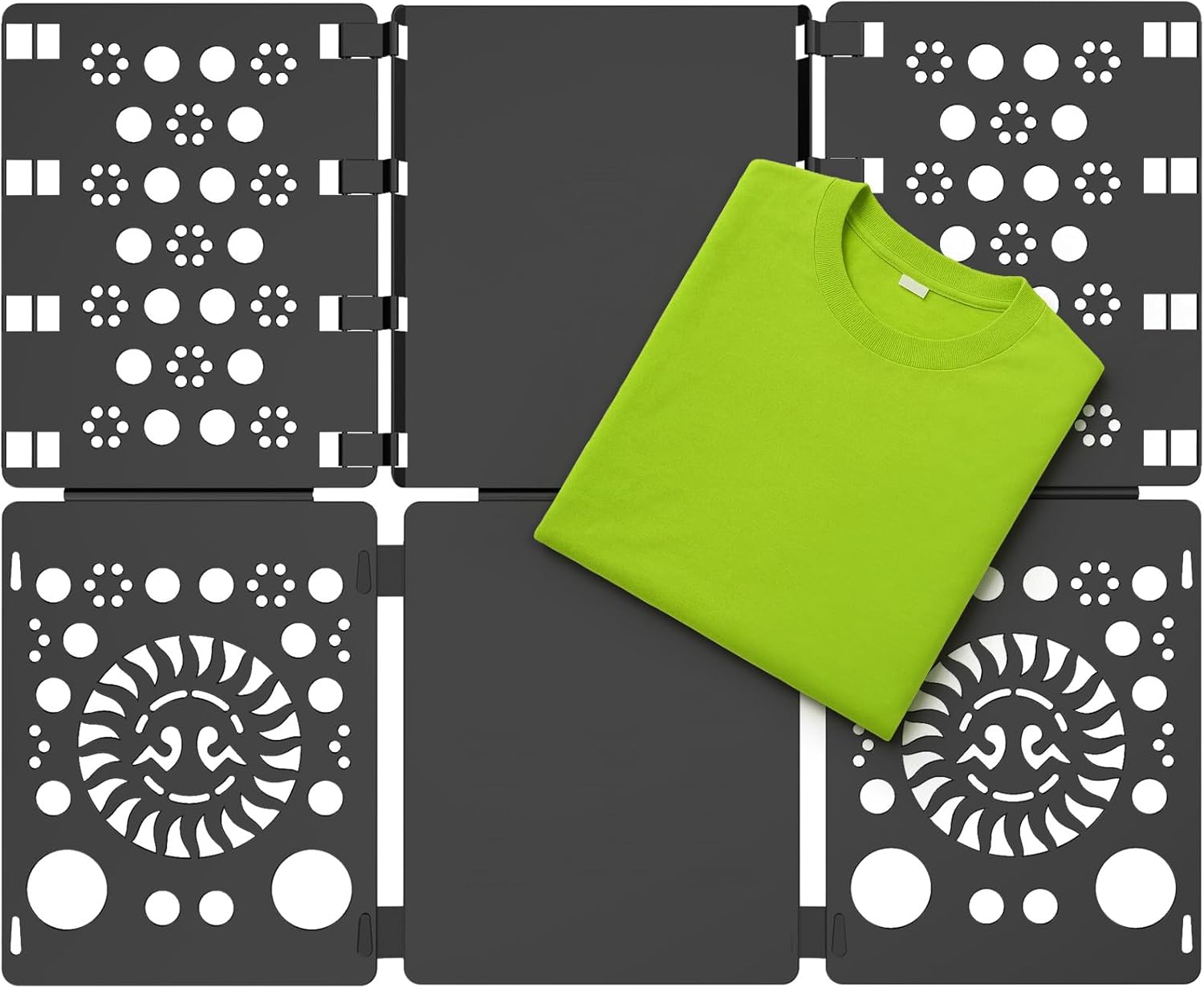
Quick Answer: The Best Laundry Folding Boards create a finished rectangle that fits your drawers and shelves, not merely the largest shirt the open panels can hold. BoxLegend V3 is the most balanced option in this group because its verified listing combines a 27.56-by-22.44-inch open surface, PP construction, an 11.6-by-9.5-inch folded storage size, hanging holes, and compatibility claims for shirts, pants, pajamas, and towels. Choose BoxLegend V7 for metal edges and joints, V4 for a larger adult-garment surface, Geniusidea for silicone connector buckles, or Household Essentials for a compact handle template.


Top Picks at a Glance
These Best Laundry Folding Boards cover standard hinged plastic, metal-edged, enlarged, connector-stabilized, and compact template styles. Speed, durability, perfect-fold, wrinkle, child-use, space-saving, and garment-range statements are listing claims rather than independent test results.
- Best Overall: BoxLegend V3 Shirt Folder Board Tshirt Clothes Folder Folding Board, Black – a PP hinged board listed at 27.56 by 22.44 inches open and 11.6 by 9.5 inches folded, with hanging holes for storage.
- Best Metal-Edged Design: BoxLegend Shirt Folder V7 Metal for Wear Resistance Clothes Folding Board, Black – a large board with listed metal outer edges and joints, a 27.95-by-23.43-inch open size, and an 11.81-by-10.24-by-1.18-inch folded size.
- Best Enlarged Plastic Board: BoxLegend V4 Shirt Folding Board Enlarged and Widened Shirt Folder, White – a thicker PP board listed at 22.8 by 28.3 inches and 3.962 pounds for adult and extended-size garments.
- Best Connector-Stabilized Board: Geniusidea Shirt Folding Board T Shirt Folder for Adults, Black – a 27.16-by-22.44-inch PP composite board with two silicone buckles, a listed 1.3-pound weight, and 9-by-11.4-inch folded size.
- Best Compact Template: Household Essentials Shirt Folding Board for T-Shirts, Polos and Dress Shirts, Dark Grey – a 12.21-by-8.45-inch template with step-by-step guidance and an easy-glide handle for removing the folded shirt.
How to Choose the Best Laundry Folding Boards
The Best Laundry Folding Boards match three dimensions: the garment while it is spread out, the work surface while panels swing, and the drawer or shelf that receives the finished stack. Ignoring any one of those dimensions can turn a helpful organizer into an awkward tool.
Measure the Work Surface and Panel Swing
A hinged board needs more than its stated open width. The left and right panels must lift and return without hitting a wall, detergent bottle, appliance, or stack of clean clothing. The bottom flap also needs room to move, and sleeves may extend beyond the board before they are folded inward.
Mark the open dimensions on a table or counter with removable tape. Add elbow and hand clearance on both sides. BoxLegend V3 lists 27.56 by 22.44 inches, V7 lists 27.95 by 23.43 inches, V4 lists 22.8 by 28.3 inches, and Geniusidea lists 27.16 by 22.44 inches.
The Best Laundry Folding Boards sit fully supported on a clean, dry, stable surface. A board that overhangs a narrow shelf can flex at the hinges, trap fabric, or fall when a side panel is flipped.
Choose the Finished Fold Size First
Measure drawer inside width, depth, and usable height. For shelves, measure the stack area between dividers and the distance from front edge to back wall. Decide whether clothing will be stacked horizontally, filed vertically, or placed inside packing cubes or bins.
A board’s stored dimensions can hint at its center-panel width, but the final garment thickness and fold sequence also affect output. BoxLegend V3 folds for storage to 11.6 by 9.5 inches, Geniusidea to 9 by 11.4 inches, and V7 to 11.81 by 10.24 inches with listed thickness of 1.18 inches.
Test with one representative shirt before refolding an entire wardrobe. The Best Laundry Folding Boards produce stacks that slide into their destination without squeezing, curling edges, or making the drawer difficult to close.
Match Board Size to Garments
Standard hinged boards work well with T-shirts, polos, casual shirts, pajamas, shorts, and some towels. Long sleeves and wide hems usually require manual pre-folding along the board edge. The V4 listing emphasizes an enlarged format, while the V7 listing describes suitability for adult-size garments.
Children’s clothing can be centered on an adult board, but the final rectangle may be too wide for a small drawer unless the fabric is pre-folded more narrowly. Compact boards make smaller rectangles but can create thicker stacks because more fabric overlaps.
Hoodies, heavy sweaters, dresses, jeans, and sheets may exceed the comfortable thickness or reach of the panels. The Best Laundry Folding Boards help establish alignment; they do not remove the need to shape overhanging fabric by hand.
Board Styles and Materials
Hinged flip boards use side panels and a lower panel to establish a repeatable sequence. PP and PP-composite plastic keep weight moderate and allow integral or connected hinges. Flexibility can help panels move, but excessive bending and backward folding can fatigue joints.
BoxLegend V7 lists metal outer edges and joints. Reinforcement may reduce deformation at some contact points, while the additional material increases stored thickness and weight. Metal still needs inspection for looseness, bending, sharp edges, corrosion, and points that could catch knit fabric.
Geniusidea lists two silicone buckles intended to stabilize its connections. Check that connectors remain seated and do not stretch, tear, twist, or protrude into the folding path. No connector eliminates the need to support the board and move panels within their intended range.
Household Essentials uses a different template format. The garment folds around a compact 12.21-by-8.45-inch board, and a smooth-glide handle helps remove the template. This style stores easily and has fewer large moving panels, but it requires the operator to fold each garment edge manually.
The Best Laundry Folding Boards balance surface smoothness, hinge control, weight, and storage. Material names alone do not predict hinge-cycle life or resistance to cracking.
Folding Technique for Consistent Results
Button or zip only what the garment care and folding method require. Lay the shirt face down or face up according to the board instructions, center the collar, align the vertical centerline, and smooth the fabric without pulling it out of shape.
Pre-fold long sleeves, wide sides, or a long hem along the panel boundaries. Keep the fabric flat at each joint. Flip one side panel through its complete motion, return it gently, then repeat the opposite side. Use the lower panel last if that is the product’s instructed sequence.
Lift the finished garment by supporting it rather than dragging it across hinges. Place it directly in the drawer or stack with the same orientation as previous garments. Consistency comes from the same centering point, sleeve fold, panel order, and final placement.
The Best Laundry Folding Boards do not require force. If a panel stalls, stop and check for trapped cuffs, drawstrings, thick seams, zippers, or fabric beneath a connector. Forcing the motion can crease details, stretch fabric, or damage the board.
Thick, Delicate, and Detailed Garments
Thick hoodies and sweaters create more layers at the center, especially when sleeves and side panels overlap. Fold them loosely or use a manual method if the panel must be pressed hard to complete its motion. Compression is not the same as a neat fold and can set unwanted creases.
Place hoods flat above the collar or fold them separately according to the garment shape. Keep buttons, snaps, zippers, buckles, screen prints, sequins, embroidery, and raised decoration away from hard hinge pressure. A protruding zipper pull can scratch plastic or leave an imprint.
Delicate knits can stretch when the hem is pulled to reach a guide edge. Align naturally and accept a slightly different finished size rather than distorting the garment. Read care labels before folding items that should hang, remain rolled, or avoid prolonged creasing.
The Best Laundry Folding Boards organize suitable clean, dry garments. They do not remove wrinkles, replace ironing or steaming, sanitize clothing, or make every fabric safe for a compact folded stack.
Table Setup and Finger Safety
Clear the work surface of detergent, hot appliances, scissors, hangers, drinks, and loose hardware. Wipe away grit that could mark clothing. A dedicated area may be arranged on one of the best laundry countertops, provided the board is fully supported and does not block machine controls.
Hold panel edges away from hinge gaps. Move one panel at a time at a controlled speed and keep the other hand outside its landing area. Do not bend a panel backward, slap it down, sit on it, or use the board as a cutting, ironing, or pressing surface.
Children may enjoy participating, but listing language about children does not replace adult supervision. Demonstrate slow movement, keep small fingers away from joints, choose lightweight garments, and store the board when the activity ends. Stop use when an edge becomes sharp or a connector loosens.
The Best Laundry Folding Boards make the sequence visible without becoming toys. A stable table and calm pace protect fingers, garments, and hinges better than rapid flipping.
Storage, Cleaning, and Hinge Care
Fold the panels only in their designed direction and store the board flat or on supported hanging holes when the manufacturer permits it. Do not wedge it behind a vibrating appliance, lean heavy boxes against it, or leave it in direct sun or high heat where plastic may warp.
Use a dry or lightly damp soft cloth and a cleaner compatible with the listed material. Do not soak hinges, silicone connectors, metal edges, or printed instructions. Dry every surface before folding the board closed so moisture and lint are not trapped between panels.
Inspect plastic whitening, cracks, split hinge lines, bent edges, loose fasteners, stretched connectors, rough burrs, and panels that no longer lie flat. Retire a damaged board rather than taping a sharp joint that contacts clean garments.
Keep the tool accessible but separate from chemicals using ideas from the best laundry room organizers. After folding, fully dry garments before placing special clothing in garment bags for storage. The Best Laundry Folding Boards support orderly storage only when both board and clothing are clean and dry.
Common Mistakes and Limitations
- Buying before measuring drawers: A uniform fold is still wrong when it does not fit the destination.
- Using an undersized table: Unsupported panels flex and clothing catches on the edge.
- Mis-centering the collar: Every later fold becomes uneven.
- Stretching fabric to the guide: Knits can distort and hems can twist.
- Leaving sleeves under hinges: Trapped fabric stalls the panel and creates hard creases.
- Forcing thick garments: Hoodies, sweaters, and jeans may need a looser manual fold.
- Flipping too quickly: Fingers, fabric, and connectors can enter the moving joint.
- Storing the board bent: Panels can warp and no longer form a flat guide.
- Expecting wrinkle removal: A folding board shapes a stack but does not press fabric.
The Best Laundry Folding Boards can improve consistency, but they cannot guarantee faster laundry, perfect retail folds, more closet capacity, or compatibility with every garment.
How We Tested and Evaluated
We did not conduct independent folding-speed, finished-size, hinge-cycle, flex, impact, scratch, wrinkle, child-use, cleaning, warp, or lifecycle tests. We evaluated Crawlbase-captured Amazon pages for exact identity, open and folded dimensions, listed weight, materials, metal edges, joints, silicone connectors, handle, hanging holes, and stated garment range.
Our assessment of the Best Laundry Folding Boards prioritizes drawer fit, work-surface clearance, garment alignment, controlled panel movement, finger position, material inspection, compact storage, and realistic limits for thick or delicate clothing. Performance statements remain listing claims.
Buying Checklist
Use this checklist to choose the Best Laundry Folding Boards for the clothes, furniture, and available work area.
- Measure drawer inside width, depth, height, shelf space, bins, and packing cubes.
- Decide the finished fold width and orientation before comparing open board size.
- Measure the table or counter plus panel-swing and elbow clearance.
- Match adult, child, extended-size, long-sleeve, sweater, pants, towel, and travel needs.
- Compare PP plastic, composite panels, metal edges, hinges, silicone buckles, or a handle template.
- Check open dimensions, folded storage dimensions, weight, thickness, and hanging holes.
- Inspect for smooth contact surfaces and accessible pinch points.
- Plan a slow folding sequence and supervision for children.
- Follow material-specific cleaning and dry the board before closing it.
- Replace cracked hinges, sharp edges, bent metal, or loose connectors.
Frequently Asked Questions
Do shirt folding boards save time?
They can make alignment and finished size more repeatable, but actual time depends on setup, garment type, sleeves, thickness, practice, and putting clothes away. Faster folding is not guaranteed.
What size board is best for adult shirts?
Choose an open board that supports the shirt body and a finished fold that fits the drawer. Verified full-size options here are roughly 27 to 28 inches by 22 to 23 inches, with one enlarged model about 22.8 by 28.3 inches.
Can one board fold children’s clothes?
Yes, many adult boards can center smaller garments, but their standard finished width may be large for children’s drawers. Extra pre-folding or a smaller template may work better.
Can a folding board handle pants and towels?
Some listings include pants and towels. Pre-fold long or wide fabric to the panel boundaries, avoid excessive thickness, and use a manual method when the board strains or traps layers.
Does a folding board remove wrinkles?
No. It creates a repeatable shape. Clothing should already be clean, dry, and suitably smooth; pressing or steaming is a separate process governed by the care label.
How can I prevent cracked hinges?
Fully support the board, clear trapped fabric, move panels within their designed direction, avoid slapping or reverse bending, store it flat, and stop using it when plastic whitens or splits.
Final Decision
BoxLegend V3 offers a balanced open size, compact storage, PP construction, and broad garment claims. V7 adds metal edges and joints, V4 provides an enlarged surface, Geniusidea adds silicone connector buckles, and Household Essentials offers a compact template with a removal handle.
The Best Laundry Folding Boards begin with the finished drawer size. Measure the work surface, center garments without stretching, prepare sleeves and overhang before moving panels, keep fingers clear of every joint, supervise children, and store the clean board flat before the next laundry cycle.