Quick Answer: The Best Marble Cleaners are explicitly approved for marble and gentle enough for its acid-sensitive calcite surface. Granite Gold Daily Cleaner for Granite, Marble & Other Natural Stone & Quartz Surfaces, 32 Ounces is the broadest ready-to-use choice because it is pH balanced, made for daily stone care, and listed for food-preparation surfaces. Choose MORE Stone & Quartz Cleaner + Protector when you want routine cleaning plus reinforcing protection, method Daily Granite Cleaner for sealed stone and a scented formula, Marblelife InterCare for acid-free multi-area care, Black Diamond Stoneworks for concentrated floor cleaning, Granite Gold Shower Cleaner for routine stone-bath maintenance, or the acid-free Natural Stone Soap Scum Remover for heavier shower residue.



Top Picks at a Glance
- Best Overall Daily Spray: Granite Gold Daily Cleaner for Granite, Marble & Other Natural Stone & Quartz Surfaces, 32 Ounces – a pH-balanced spray for listed natural stone, quartz, counters, floors, and bathroom vanities.
- Best Cleaner and Protector: MORE Stone & Quartz Cleaner + Protector – Water-Based Surface Spray – Granite, Quartz & Marble Cleaner – For Kitchen & Bathroom Countertops & Floors – Peppermint-Thyme Essential Oil – Pint (16oz) – a neutral-pH two-in-one formula for routine stone and quartz care.
- Best for Sealed Stone: method Daily Granite Cleaner Spray, Apple Orchard, 28 fl oz | Cleans and Polishes, For Use on Granite, Marble, and Other Sealed Stone – a ready-to-use scented spray intended for sealed surfaces.
- Best Acid-Free Multi-Area Cleaner: Marblelife InterCare Marble and Travertine, Natural Stone & Terrazzo Liquid Cleaner, Shower & Tile Surface Care, Floor, Walls & Countertop Cleaner and Degreaser, 32 oz – a cleaner for counters, vanities, showers, walls, and floors that does not claim to repair etching.
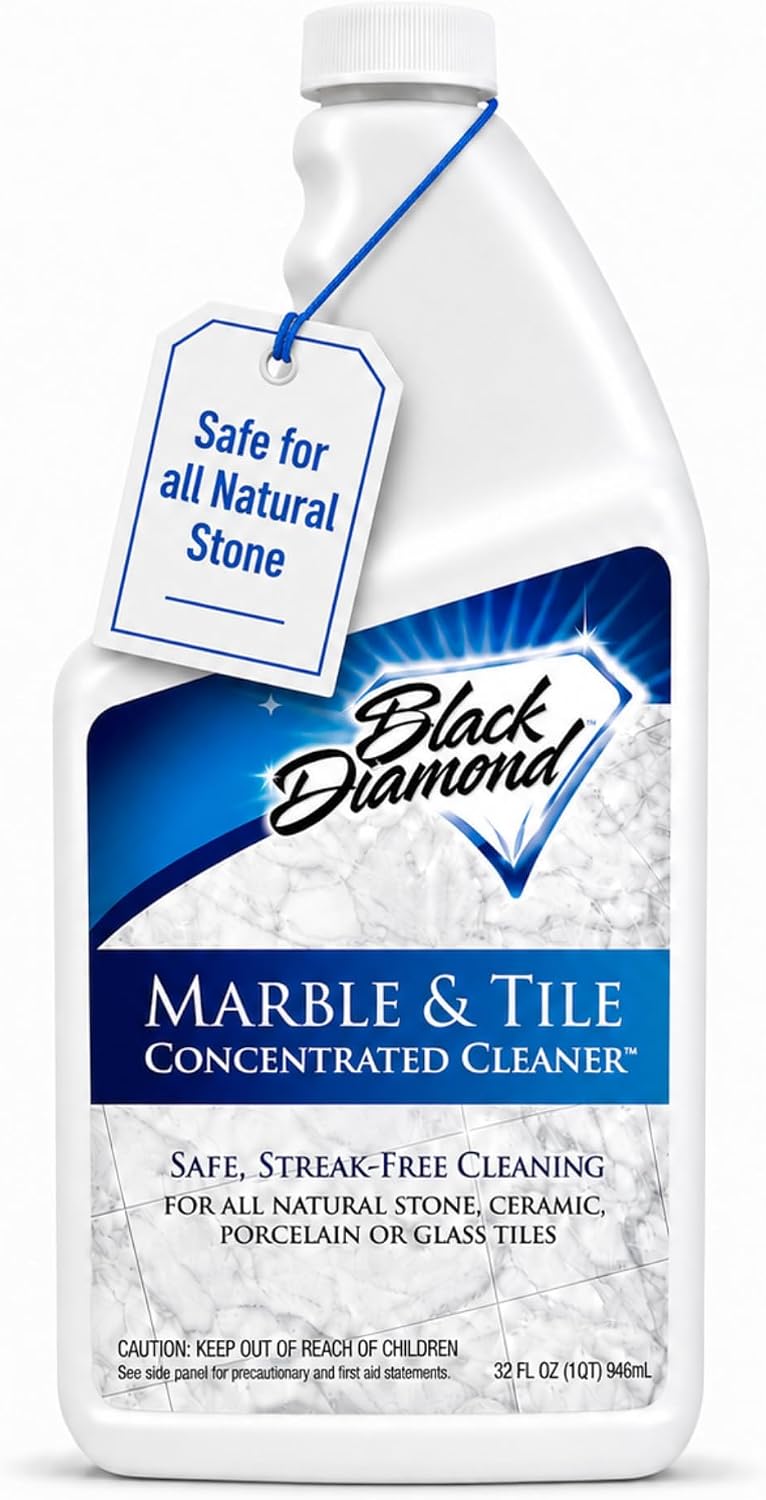
- Best Floor Concentrate: Black Diamond Stoneworks Marble & Tile Floor Cleaner Concentrate, 1 Quart | pH Neutral, Streak-Free & No-Rinse Formula, For Granite, Travertine, Limestone, Slate, Ceramic & Porcelain Floors – a pH-neutral concentrate for compatible natural-stone and tile floors.
- Best Routine Shower Spray: Granite Gold Shower Cleaner Spray for Quartz, Granite, Marble, Ceramic, and Other Stone Tub Surfaces, Made in the USA, 24 Ounces, Gold – a stone-specific bathroom spray positioned for soap scum and hard-water maintenance.
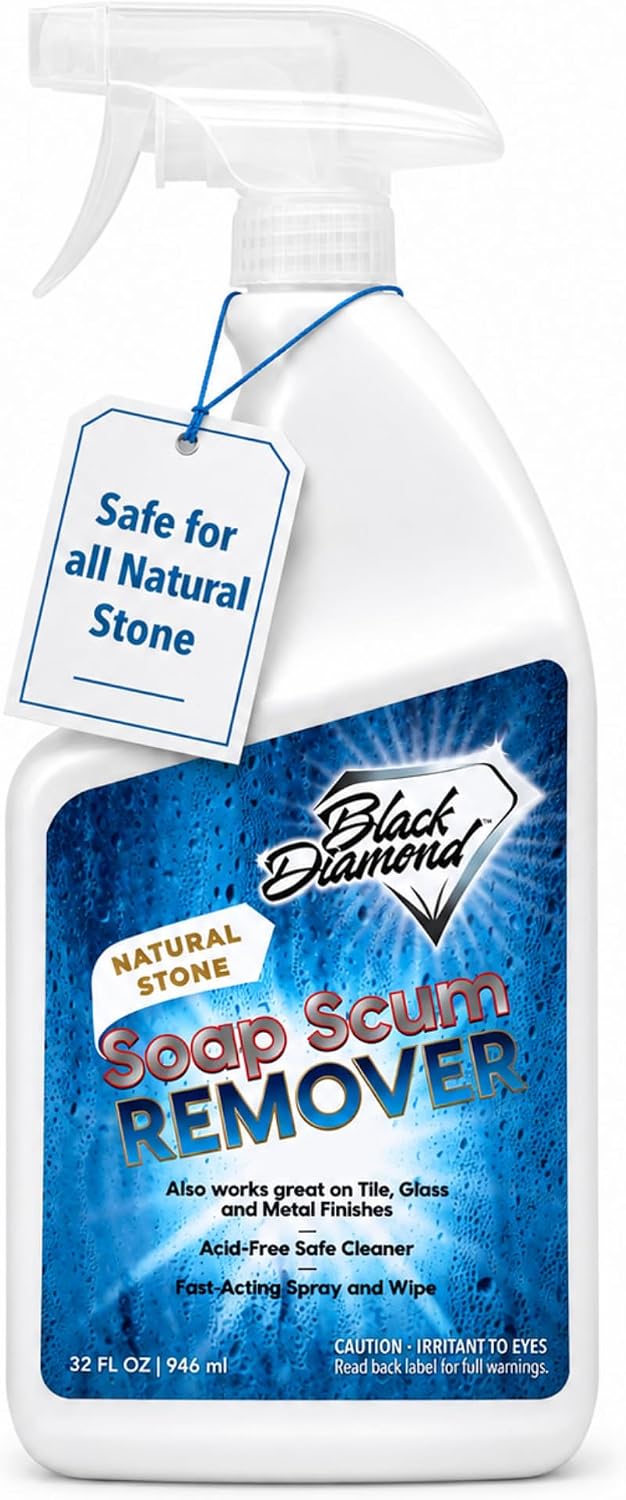
- Best for Shower Soap Scum: Natural Stone Soap Scum Remover for Showers, Glass Doors & Acid-Free. 1-QT | Natural Stone Safe Shower Cleaner, For Marble, Granite, Travertine, Tile & Glass, Removes Soap Scum – an acid-free option for compatible shower stone, tile, glass, and acrylic.
The Best Marble Cleaners remove everyday soil without promising to fix physical damage. A cleaner can lift grease, dust, body oil, light soap residue, and some surface deposits, but it cannot replace missing polish, fill a scratch, remove every absorbed stain, or rebuild stone dissolved by acid.
Identify the Marble, Finish, and Problem First
Marble is largely made of calcite, which reacts with acids. Lemon juice, vinegar, acidic bathroom cleaner, rust remover, and many limescale formulas can leave a pale or dull mark even after immediate wiping. That mark is etching: a change to the stone itself, not dirt sitting on top.
Polished marble reflects light and makes dull etches easy to see. Honed marble has a matte finish, so damage may appear as a lighter or darker patch instead. Cultured marble is an engineered resin-and-mineral product with different care rules. Terrazzo, quartzite, quartz, porcelain, and granite can resemble marble but are not interchangeable.
Sealer also changes the cleaning plan. A penetrating sealer slows absorption but does not create an acid-proof coating. A topical finish can react to chemicals differently from bare stone. The Best Marble Cleaners must match both the stone and any coating, grout, caulk, metal trim, or adjacent material.
How to Choose the Best Marble Cleaners
Require Explicit Marble Compatibility
A generic multipurpose label is not enough. Look for marble in the product directions, then check whether the formula is limited to sealed stone, polished stone, floors, counters, or showers. Granite Gold, MORE, method, Marblelife, Black Diamond Stoneworks, and both shower selections list marble or natural-stone uses, but their intended applications differ.
When a counter fabricator, floor installer, shower contractor, or coating maker gives stricter instructions, those instructions control. The Best Marble Cleaners do not override a warranty, restoration treatment, specialty sealer, or care label.
Choose pH-Neutral or Acid-Free Care
Neutral-pH and acid-free positioning helps reduce the most obvious marble risk, but it is not a universal guarantee. Fragrance oils, solvents, surfactants, concentration errors, long dwell time, and residue can still affect appearance. Always test the exact product at the intended dilution.
Do not substitute vinegar because it is described as natural, and do not assume diluted acid becomes marble-safe. Acid can react before it is wiped away. Likewise, alkaline oven cleaner, strong degreaser, bleach mixture, and abrasive powder can damage sealer, grout, metal, or finish even when they do not create the same acid etch.
Match Ready-to-Use Spray or Concentrate to the Job
Ready-to-use sprays suit counters, vanities, and small sections because they control volume and require no measuring. Granite Gold, MORE, method, Marblelife, and the two shower formulas fit this approach. Spray onto a cloth instead of directly onto seams, fixtures, or porous edges when the label permits.
A concentrate is more practical for large floors, but inaccurate dilution can leave residue or increase chemical exposure. Black Diamond Stoneworks is the selected floor concentrate. Use the current label ratio, clean water, and a dedicated measuring method rather than estimating in a mop bucket.
The Best Marble Cleaners also fit the cleaning tool. A soft microfiber cloth works for counters; a clean microfiber mop reduces grit drag on floors; and a non-scratch pad may help a shower only when both the stone and product instructions allow it.
Decide Between Cleaner-Only and Cleaner-Protector
Cleaner-only formulas make it easier to judge whether soil has been removed and whether the surface needs a separate maintenance step. A cleaner-protector such as MORE reinforces stain protection during cleaning, which is convenient for routine care.
Protection language does not mean the product replaces a penetrating sealer or repairs failed sealing. Water darkening, rapid absorption, or recurring stains may justify a fabricator-approved sealer assessment. Applying more protectant over trapped soil can produce haze rather than solve the underlying issue.
Consider Food Areas, Fragrance, and Residue
Kitchen marble may contact food, cutting boards, appliances, and dishware. Granite Gold lists food-preparation-surface use, but every product still needs its label-directed wipe, rinse, or drying process. Do not prepare food directly on a wet or unrinsed surface unless the directions explicitly allow it.
MORE uses a peppermint-thyme scent and method uses Apple Orchard. Fragrance preference is personal, but scent does not indicate cleaning strength or safety. Unscented or low-odor care may be preferable in small bathrooms, around sensitive users, or where stone surrounds food.
The Best Marble Cleaners should dry without a sticky film. Streaks can come from excess product, dirty cloths, hard water, incorrect dilution, polish buildup, or moving soil around rather than removing it.
Separate Counter, Floor, and Shower Requirements
Countertops need controlled moisture around seams, backsplashes, sinks, faucets, appliances, and wood cabinetry. Floors need grit removal, correct dilution, and a mop that does not flood grout or edges. Showers need longer contact on vertical soap film while protecting caulk, drains, glass coatings, and metal finishes.
A daily counter spray is not automatically economical for a large floor, and a floor concentrate may be awkward on a vertical shower wall. For non-marble materials, compare dedicated granite cleaners or tile cleaners rather than assuming one stone formula is ideal everywhere.
Recommendations by Application
Kitchen Countertops and Islands
Granite Gold is the broadest daily option, while MORE adds cleaner-protector convenience and method targets sealed stone with a scented finish. Remove crumbs first so the cloth does not drag grit. Wipe spills promptly, especially citrus, wine, tomato, vinegar, and carbonated drinks.
Do not use the marble as a cutting surface. Scratches, acidic food, hot cookware, and oil can create damage that routine cleaning cannot reverse. The Best Marble Cleaners support a care system that also includes boards, trivets, coasters, and prompt blotting.
Bathroom Vanities
Granite Gold, MORE, or Marblelife can handle routine vanity soil when the finish is compatible. Protect the stone from toothpaste, cosmetics, hair dye, perfume, nail products, and acidic skincare. Wipe around faucet bases without flooding seams or plated hardware.
Marble Floors
Black Diamond Stoneworks is the purpose-selected concentrate, while Marblelife also lists floor use. Vacuum with a hard-floor tool or use a clean dust mop before wet cleaning. Sand and grit are abrasives; removing them often matters more than using a stronger chemical.
Work in manageable sections, prevent standing water, and follow the stated rinse requirement. Broader floor cleaning solutions may suit other floor types, but marble needs its own compatible formula and tool settings.
Marble Showers and Tub Surrounds
Granite Gold Shower Cleaner is the routine-maintenance selection. The acid-free Natural Stone Soap Scum Remover is aimed at heavier soap residue, while Marblelife provides another multi-surface option. Ventilate, protect adjacent finishes, and prevent cleaner from drying on the wall.
Hard-water marks present a special problem because ordinary acidic descalers can etch marble. Start with a stone-safe shower process and professional advice for persistent mineral crust. A general guide to bathroom cleaners should not be treated as automatic approval for natural stone.
Mixed Stone, Tile, Glass, and Grout
Mixed installations fail at their most sensitive material. A formula may be safe for marble but not for tinted grout, coated glass, acrylic, brass, or a topical sealer. Apply with control, rinse transitions carefully, and test every visibly different finish.
Trade-Offs to Consider
- Ready-to-use convenience versus cost per area: sprays control application, while concentrate usually covers larger floors.
- Cleaner-only clarity versus added protection: a two-in-one formula saves a step but does not replace sealer evaluation.
- Fragrance versus sensitivity: scented products may improve the experience but can be undesirable in enclosed rooms.
- No-rinse convenience versus residue control: correct dilution and clean tools still determine whether a film remains.
- Soap-scum removal versus finish protection: more dwell and agitation can increase risk to polish, grout, and adjacent materials.
- Daily maintenance versus restoration: gentle cleaners preserve intact stone but cannot remove deep stains or repolish an etch.
The Best Marble Cleaners balance soil removal with preservation of finish, sealer, grout, and surrounding materials.
Common Mistakes to Avoid
Do not use vinegar, lemon, acidic limescale remover, toilet cleaner, or an unknown bathroom spray on marble. Never mix cleaning chemicals, especially bleach with acids or ammonia.
Do not scrub with steel wool, abrasive powder, a rough green pad, or gritty melamine foam without stone-professional approval. A product can be chemically compatible while the applicator scratches the finish.
Avoid flooding floors, vanity seams, sink cutouts, shower corners, and stone edges. Water can carry soil into grout, reach cabinetry, darken unsealed areas, or expose installation problems.
Do not assume a stain, etch, scratch, or sealer failure needs stronger cleaner. Marblelife explicitly states that its selected cleaner is not a stain remover or restorative treatment. The Best Marble Cleaners stop where poulticing, honing, polishing, repair, or resealing begins.
Spot-Test and Cleaning Checklist
Use this checklist with the Best Marble Cleaners:
- Confirm natural marble, cultured marble, or another look-alike material.
- Identify polished, honed, sealed, coated, or unknown finish.
- Check the label for marble and the exact application area.
- Remove loose grit before adding liquid.
- Test a hidden matching section and let it dry fully.
- Use the exact concentrate dilution and dwell time.
- Keep cleaner away from incompatible metal, wood, electronics, and coatings.
- Wipe with clean microfiber and change cloth faces as they collect soil.
- Inspect for haze, darkening, gloss change, residue, or color transfer.
- Stop if the mark appears to be damage rather than removable soil.
Prevention, Sealing, and Storage
Blot spills instead of spreading them. Use pH-compatible routine cleaning before residue builds into a difficult film. Dry shower walls and vanity tops, place mats at entrances, add felt under decorative objects, and keep abrasive grit off floors.
Sealing schedules depend on stone porosity, finish, product, use, and installation. A calendar alone cannot prove resealing is needed. Ask the installer or stone professional how to assess water absorption and which sealer is compatible.
Store cleaners upright in original labeled containers, away from food, heat, children, pets, and incompatible chemicals. Keep concentrate measuring tools separate from kitchen utensils. The Best Marble Cleaners remain identifiable and are never transferred into an unlabeled bottle.
How We Tested and Evaluated
We evaluated the Best Marble Cleaners through research-based comparison rather than claiming hands-on etch, stain, sealer, gloss, residue, shower, floor, or long-term stone testing. Every selected ASIN and exact product name was verified on its individual Amazon page.
We compared explicit marble compatibility, pH-neutral or acid-free positioning, ready-to-use and concentrate formats, cleaner-only and cleaner-protector roles, countertop, floor, and shower use, food-area directions, fragrance, rinse positioning, and limitations around etching, stains, and restoration.
Frequently Asked Questions
Can I clean marble with vinegar?
No. Vinegar is acidic and can etch calcite-based marble, even when diluted. Use a product explicitly approved for marble.
What does pH neutral mean for marble?
It means the formula is positioned near neutral rather than strongly acidic or alkaline. Compatibility still depends on concentration, finish, sealer, dwell time, and directions.
Why does my marble look dull after cleaning?
The cause may be residue, an acidic etch, abrasion, worn polish, hard-water film, or sealer behavior. Let the area dry, stop adding products, and identify the cause before repeating.
Can marble cleaner remove a deep stain?
Daily cleaner may remove surface soil but not absorbed oil, dye, rust, or organic staining. A stone-specific poultice or professional process may be required.
Does cleaner reseal marble?
No ordinary daily cleaner replaces a properly selected penetrating sealer. Cleaner-protector formulas can support maintenance but should not be treated as full resealing.
Can one marble cleaner be used on counters and floors?
Only when the label lists both uses. The Best Marble Cleaners also need the correct dilution, tool, moisture level, and food-area process for each application.
Final Decision
The Best Marble Cleaners fit the exact stone, finish, and area. Granite Gold is the broadest daily spray. Choose MORE for cleaning plus reinforcing protection, method for sealed stone and fragrance, Marblelife for acid-free multi-area care, Black Diamond Stoneworks for floor concentrate, Granite Gold Shower Cleaner for routine bathroom maintenance, or the acid-free Natural Stone Soap Scum Remover for heavier shower film.
Confirm the material, remove grit, spot-test, control moisture, and never use acid to chase a mark on marble. Gentle maintenance protects intact stone; etching, deep stains, failed sealer, and lost polish require a different solution.