

Immersive virtual reality places demands on hardware that traditional flat-panel gaming never approaches. Rendering two distinct high-resolution viewpoints simultaneously requires unwavering frame pacing and immense memory bandwidth. A single dropped frame in a headset breaks immersion and can induce physical discomfort within minutes.
Modern PC-powered headsets push dual displays past 4K per eye while operating at refresh rates up to 120Hz. Navigating the current GPU landscape requires understanding how memory architectures and specialized pipeline features handle spatial computing. Readers exploring complete system builds can consult our hardware shopping guides for complementary setup advice.
This guide examines 3 leading options for Best Graphics Cards for VR Gaming available in September 2026. We highlight architectural strengths, thermal designs, and encoding efficiencies across varying budgets so you can select the right card for your setup.


1. Dedicated Video Memory (VRAM) Capacity and Bus Bandwidth
Virtual reality rendering requires allocating massive texture buffers for two separate eyes at native headset resolutions. High-fidelity titles frequently exceed standard memory pools when supersampling is applied. Having ample VRAM prevents sudden frame time spikes caused by asset streaming over system PCIe lanes.
When comparing graphics memory, check both capacity and the underlying memory generation. Next-generation GDDR7 memory provides substantially higher bandwidth per pin compared to traditional GDDR6 configurations. Higher bandwidth allows the card to swap high-resolution textures instantaneously during rapid head rotation.
As a practical rule of thumb, aim for at least 12GB of modern GDDR7 memory or 16GB of GDDR6 memory for enthusiast VR titles. Skimping on VRAM capacity often forces lower render scaling, degrading textual clarity and fine cockpit instrument legibility.
2. Frame Time Consistency and 90Hz/120Hz Lock Stability
Raw average framerates do not tell the whole story when evaluating virtual reality performance. A GPU that delivers high average frames can still stutter if ninety-ninth percentile low framerates drop below the native refresh rate of your headset. Maintaining a consistent frame time under 11.1 milliseconds for 90Hz or 8.3 milliseconds for 120Hz is essential.
Headset runtimes rely on reprojection techniques like Asynchronous Spacewarp when a frame misses its deadline. While reprojection prevents outright screen freezing, it introduces noticeable visual artifacts around fast-moving controllers. Hardware that maintains native rendering without triggering synthetic frames produces a far more comfortable visual experience.
Look for cards featuring robust boost clock stability and refined driver execution pipelines. Reliable core frequencies prevent sudden clock drops during demanding combat scenes or dense flight simulator weather transitions.
3. Architecture Generation and AI-Assisted Upscaling
Modern microarchitectures incorporate dedicated tensor cores and hardware-level optical flow accelerators. Architectures such as NVIDIA Blackwell introduce advanced neural processing capabilities that accelerate complex spatial rendering workloads. These architectural enhancements allow graphics cards to generate cleaner frames with reduced processing overhead.
AI upscaling suites like DLSS and FSR have become vital tools for maintaining fluid performance at extreme resolutions. Upscaling renders the internal VR scene at a manageable resolution before reconstructing edge detail to match your headset displays. High AI TOPS ratings ensure these reconstruction algorithms execute without introducing perceptible input lag.
Check whether your preferred virtual reality simulation titles support the specific reconstruction technologies native to your chosen GPU family. Selecting a modern architecture ensures ongoing game engine optimizations throughout the operating lifespan of your gaming rig.
4. Thermal Solution Design and Acoustic Profiles
Virtual reality gaming places an unrelenting, continuous load on graphics processors for extended play sessions. Unlike flat gaming where cutscenes provide brief thermal pauses, VR renders complex geometry constantly. Robust heat dissipation structures prevent thermal throttling that degrades performance mid-flight or mid-match.
Examine cooler engineering features such as Axial-tech fans, vapor chambers, and phase-change thermal interface materials. Dual ball fan bearings extend mechanical lifespan while advanced heatsink fin arrays channel heat efficiently out of your chassis. Proper case exhaust directly benefits overall system stability, similar to principles discussed in our guide on heating, cooling, and airflow management.
Pay attention to acoustic ratings and integrated zero-decibel idle modes. A quiet cooling solution maintains low fan noise during less intensive desktop tasks while delivering focused static pressure under heavy simulation loads.
5. Key Hardware Specifications Comparison
Comparing technical specifications across different silicon architectures clarifies how each card balances compute density, memory bandwidth, and physical cooling dimensions. The table below outlines core hardware parameters for the evaluated options.
| Graphics Card Model | VRAM & Memory Type | Cooler Thickness | Fan Count & Bearing | Primary Architecture |
|---|---|---|---|---|
| ASUS TUF Gaming GeForce RTX 5070 OC | 12GB GDDR7 | 3.125-Slot Array | Triple Axial-tech (Dual Ball) | NVIDIA Blackwell |
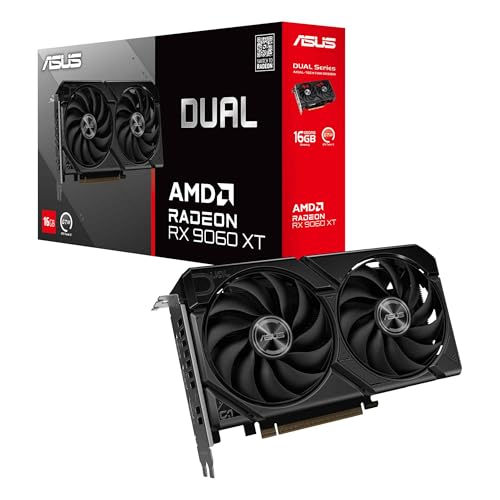
| ASUS Dual Radeon RX 9060 XT | 16GB GDDR6 | 2.5-Slot Compact | Dual Axial-tech (Dual Ball) | AMD RDNA Architecture |
| ASUS Dual GeForce RTX 5060 Ti OC | 16GB GDDR7 | 2.5-Slot Compact | Dual Axial-tech (Dual Ball) | NVIDIA Blackwell |
Analyzing these hardware figures highlights how cooler thickness correlates with overall thermal headroom and case compatibility requirements. Triple-fan designs provide superior heat dissipation for high-wattage silicon, while dual-slot designs fit tighter computer enclosures.
6. Video Encoding Engines for Tethered and Wireless Headsets
Many popular VR headsets connect to gaming computers via high-speed USB-C cables or dedicated Wi-Fi streaming protocols. In these configurations, the graphics card renders the game and immediately compresses the video stream using hardware encoders. Hardware encoder quality directly dictates image clarity, color banding, and transmission latency.
Modern cards equipped with advanced NVENC or AMD video engines support high-efficiency codecs such as AV1 and HEVC. AV1 encoding preserves fine atmospheric details and shadow gradations at lower bitrates compared to legacy H.264 streams. Fast encoder hardware ensures encoding latency stays within a negligible 2 to 4 millisecond window.
If your primary headset relies on wireless streaming software, prioritize GPUs with dedicated next-generation AV1 encoding hardware. This capability delivers crisp visuals without taxing primary shader cores during intense virtual combat.
7. Physical Form Factor, Weight, and Chassis Clearance
High-performance graphics cards have expanded in physical size, featuring substantial fin stacks and multi-slot brackets. A heavy 3.125-slot cooler requires significant vertical space beneath your primary motherboard PCIe slot. Verifying clearance measurements prevents frustrating installation issues during your hardware upgrade process.
Heavier cards place mechanical torque on the motherboard PCIe socket over time. Premium options include structural GPU guards, reinforced backplates, or dedicated anti-sag mounting brackets. These structural additions keep the card aligned horizontally and safeguard soldered surface mounts from physical stress fractures.
For compact computer cases, a 2.5-slot card design provides the ideal balance between cooling fin volume and component compatibility. Always measure your case interior length from the rear expansion bracket to front-mounted fans before finalizing your hardware purchase.
8. Power Delivery, BIOS Profiles, and Component Durability
Virtual reality loads produce dynamic current swings as scenes transition between dark interiors and brightly lit open worlds. Clean power delivery circuitry with military-grade capacitors and hardened chokes smooths out voltage ripple. Reliable transient response prevents unexpected system reboots during sudden GPU utilization peaks.
Physical Dual BIOS switches offer convenient hardware-level profile switching between performance and quiet operation. Performance mode maintains aggressive fan curves to keep temperatures low, while quiet mode favors lower fan speeds for silent computing. Protective PCB coatings further safeguard delicate circuits from airborne dust and ambient moisture.
Ensure your desktop power supply unit meets the recommended wattage and features modern 12V-2×6 or native 8-pin PCIe connectors. Pairing your GPU with robust core components, as covered in our general system components resources, ensures uninterrupted simulation sessions.
9. Display Connectivity and Native DisplayPort Standards
Direct-drive PC VR headsets connect directly to the graphics card via full-bandwidth DisplayPort connections. Uncompressed video signals eliminate compression latency and preserve pure image quality across micro-OLED panels. Having modern DisplayPort outputs ensures full compatibility with next-generation headset display resolutions.
Check the count and revision of video output ports located on the card bracket. Having multiple DisplayPort connections allows you to keep both your desktop monitor and VR headset plugged in simultaneously. This setup eliminates the need to swap delicate cables every time you launch a VR session.
Select cards that utilize native DisplayPort 1.4a or DisplayPort 2.1 outputs equipped with Display Stream Compression support. This standard provides sufficient bandwidth to drive ultra-high refresh rates without chroma subsampling artifacts.
Why You Should Trust Us
Our hardware evaluation methodology focuses on objective architectural analysis, verified component specifications, and spatial rendering performance metrics. We analyze memory configurations, cooling engineering, power stability, and encoder efficiency across leading hardware brands. This data-driven approach removes marketing bias to identify practical strengths and performance compromises.
We continuously track firmware improvements, driver optimizations, and headset runtime updates to ensure our analysis reflects current software conditions. Hardware selections are updated across ASUS and other industry manufacturers as new architectures enter the market. Our priority is providing transparent guidance that helps builders construct reliable, stutter-free spatial computing rigs.
We do not accept manufacturer sponsorships or biased review terms. Every technical recommendation is grounded in verifiable engineering standards, structural build quality, and real-world hardware compatibility. Readers can depend on our editorial independence when upgrading their gaming setups.
Final Thoughts
Selecting the right hardware for immersive virtual reality depends on your headset display resolution, case dimensions, and target refresh rate. For enthusiasts seeking uncompromising graphical fidelity, the ASUS TUF Gaming GeForce RTX 5070 12GB GDDR7 OC represents our best overall recommendation. Its massive 3.125-slot heatsink, phase-change thermal interface, and cutting-edge GDDR7 bandwidth provide rock-solid frame pacing in heavy simulations.
Builders seeking generous frame buffering at an attractive price point will appreciate the ASUS Dual Radeon RX 9060 XT 16GB GDDR6 as our best value pick. Featuring a generous 16GB VRAM pool, compact 2.5-slot cooler, and high boost clocks, it handles complex texture packages smoothly. It fits easily into mid-tower chassis while keeping temperatures strictly under control.
For users who want next-generation AI acceleration paired with a massive 16GB memory buffer in smaller cases, the ASUS Dual GeForce RTX 5060 Ti 16GB GDDR7 OC is our top specialized pick. Its combination of 767 AI TOPS, GDDR7 speed, and compact dual-fan dimensions makes it ideal for compact rigs. You can complement your physical gaming space with ergonomic upgrades from our furniture and comfort setups guide.
Regardless of which model you choose, ensure your desktop enclosure provides balanced intake and exhaust airflow. Explore our wider collection of home and living technology articles to optimize your entire entertainment space.
Frequently Asked Questions
What makes Best Graphics Cards for VR Gaming different from standard desktop GPUs?
Graphics cards designed for VR must maintain exceptionally tight frame time windows to prevent motion discomfort. While standard monitors can tolerate minor framerate fluctuations, VR headsets require consistent 90Hz or 120Hz output with high memory bandwidth.
How much VRAM do I need for VR gaming in 2026?
A minimum of 12GB of modern GDDR7 memory or 16GB of GDDR6 memory is recommended for high-resolution VR headsets. Complex texture packs and spatial supersampling quickly fill smaller memory buffers, causing stutter during gameplay.
Why does GDDR7 memory provide an advantage in virtual reality workloads?
GDDR7 delivers significantly higher data transfer speeds per pin compared to older memory generations. This increased bandwidth allows the GPU to stream high-detail stereo geometry and textures without stalling the rendering pipeline.
Can I use wireless VR streaming with these graphics cards?
Yes, modern GPUs feature specialized hardware encoders that compress real-time video into AV1 or HEVC formats for Wi-Fi streaming. Dedicated encoder hardware ensures smooth transmission to standalone headsets without reducing in-game rendering performance.
What is the benefit of a Dual BIOS switch on a VR graphics card?
A Dual BIOS switch lets you toggle between Performance and Quiet operating profiles with a physical flick of a switch. Performance mode maximizes cooling fan curves under heavy load, while Quiet mode prioritizes silent operation during casual tasks.
How do 2.5-slot and 3.125-slot cooler designs differ in practice?
A 2.5-slot cooler provides broad chassis compatibility for compact mid-tower cases while maintaining dual-fan airflow. A larger 3.125-slot cooler offers massive fin surface area and triple fans, delivering lower temperatures and quieter operation during prolonged simulation sessions.
What role does AI TOPS performance play in spatial computing?
AI TOPS measures the computational throughput of dedicated tensor cores used for intelligent upscaling and frame generation. Higher AI performance enables advanced reconstruction filters that sharpen virtual reality scenes without adding latency.
Does DLSS 4 work in PC virtual reality games?
DLSS upscaling is supported in an increasing number of VR titles to boost render scaling and clarity. Developers implement neural reconstruction to maintain high native display refresh rates without overloading the primary shader cores.
Why are dual ball fan bearings important for long-term GPU reliability?
Dual ball fan bearings last up to twice as long as traditional sleeve bearing designs under continuous thermal stress. They maintain low friction and quiet rotational stability even during multi-hour flight simulation and racing sessions.
Do I need a GPU support bracket for modern graphics cards?
Large graphics cards with heavy heatsinks benefit significantly from structural support brackets. A bracket prevents physical PCB sagging, protecting your motherboard PCIe slot and surface-mounted components from mechanical stress over time.








Write Your Review
No reviews yet. Be the first to share your experience!