

Modern legal practices, healthcare clinics, and administrative hubs still depend on direct faxing for authenticated record delivery. Finding the Best Laser Fax Machines in September 2026 ensures your team handles confidential filings without line drops, blurred text, or paper jams.
We examined 9 leading hardware solutions from top manufacturers like Canon, Brother, HP to determine which units balance throughput with low operating costs. Many offices overspend on inkjet alternatives that suffer from slow transmission speeds, smeared lines, and expensive liquid cartridges.
Selecting the right laser hardware streamlines daily workflow while keeping maintenance overhead minimal. Just as facilities optimize workstations by pairing equipment with recycling sorters for offices, selecting the proper document transceiver establishes long-term administrative efficiency.




Modem Transmission Speed and Super G3 Protocol
Modem speed determines how quickly documents transfer across traditional analog lines or digital phone adapters. Units equipped with 33.6 kbps Super G3 modems send standard pages in approximately three seconds, drastically cutting telephone toll charges. Older 14.4 kbps hardware takes more than double that time per page, creating bottlenecks during heavy batch transmissions.
Modern laser transceivers incorporate advanced JBIG compression alongside Super G3 protocols. This combination shrinks data packets before sending, ensuring crisp line drawings and fine typography arrive without distortion. High-volume administrative hubs should always confirm Super G3 compatibility before standardizing on a new office fleet.
As a practical rule of thumb, operations transmitting more than fifty pages daily will save dozens of staff hours each month by prioritizing 33.6 kbps throughput. Faster transmission also frees the telephone line quickly, preventing callers from encountering frustrating busy signals.
Automatic Document Feeder Capacity and Duplex Scanning
The Automatic Document Feeder, or ADF, dictates how many physical pages staff can scan or fax in a single unattended operation. Compact entry-level units typically provide 35-sheet or 50-sheet trays, whereas enterprise-grade workhorses feature robust 70-sheet or 80-sheet feeders. Larger feeders eliminate the need for manual reloading during lengthy legal or clinical contract transfers.
Dual-head single-pass duplex scanning represents another critical productivity enhancement. Rather than mechanically flipping each sheet, single-pass feeders scan both sides of a page simultaneously at speeds reaching up to 104 or even 200 images per minute. This reduces mechanical wear and substantially lowers the risk of paper jams on delicate original copies.
Always choose an ADF capacity that exceeds your average batch size by at least twenty percent. If your office routinely processes forty-page loan dossiers, investing in a unit with a 50-page or 80-page feeder keeps employees focused on core tasks rather than standing over the machine.
Print Engine Speed and First Page Out Time
Print engine throughput, measured in pages per minute (PPM), reflects how rapidly the laser engine produces physical documents. Modern monochrome machines range from 30 ppm for desktop applications up to an impressive 52 ppm for heavy enterprise workloads. Higher speed ratings ensure that incoming multi-page faxes and large copy jobs finish almost immediately.
Equally critical is the First Page Out Time (FPOT), which measures warm-up latency from sleep mode. Premium laser engines achieve FPOT ratings under five seconds, delivering immediate results when single-page confirmations or urgent faxes arrive. Cheaper engines often take fifteen seconds or longer to heat their fuser rollers, introducing annoying micro-delays throughout the day.
When comparing specifications, evaluate both continuous PPM and initial FPOT. A machine with 35 ppm and a 4.9-second warm-up will often complete short administrative jobs faster than a 40 ppm printer with a sluggish wake cycle.
Toner Cartridge Yield and Operating Costs
Toner yield governs your total cost per page and determines how frequently personnel must swap out consumables. Standard toner cartridges typically provide 1,200 to 3,000 pages of text, while high-yield and ultra high-yield cartridges can deliver 7,500 to 18,000 pages before replacement. Opting for high-yield supplies lowers the recurring per-page expense significantly over several years.
To calculate true running costs, divide the cartridge retail price by its rated ISO page yield. Monochrome laser hardware regularly delivers cost-per-page figures below two cents, making it vastly more economical than liquid inkjet alternatives. Managing expenses also requires comparing office consumables before buying, ensuring ongoing replenishment stays well within operating budgets.
For high-output environments, selecting a printer that accepts ultra high-yield toner prevents unexpected downtime. High-capacity cartridges also generate less packaging waste, aligning with broader office sustainability goals.
Paper Handling and Expandable Cassette Capacity
Standard paper handling on compact desktop laser units typically starts with a 150-sheet or 250-sheet enclosed cassette. Heavy-use departments benefit from enterprise models offering 520-sheet main cassettes that swallow an entire ream of paper in one loading. Expandable architectures allow adding auxiliary trays to achieve capacities exceeding 1,600 sheets.
In addition to main paper trays, dedicated multipurpose bypass slots accommodate specialized media without unloading the primary cassette. These bypass trays handle envelopes, heavy cardstock, address labels, and legal-sized paper effortlessly. Dedicated legal paper handling is particularly vital for law firms and medical record archives that frequently process non-standard dimensions.
A reliable rule of thumb is to select a paper tray capacity equal to your weekly page volume. This minimizes daily reloading cycles, keeps paper protected from ambient moisture inside sealed cassettes, and prevents premature feeding issues.
Enterprise Security and Regulatory Compliance
Fax machines frequently handle sensitive patient records, financial contracts, and personally identifiable information subject to HIPAA, FERPA, and GLBA compliance. Modern laser multifunction systems integrate enterprise-grade security protocols, including TLS encryption, secure boot validation, and automated firmware protection. These defenses prevent malicious actors from intercepting transmissions or gaining unauthorized network access.
Hardware-level safeguards such as PIN-protected secure reception and integrated NFC badge authentication ensure confidential documents never sit unattended in exit trays. Incoming faxes can be held securely in encrypted onboard memory until the designated recipient taps their credential card or enters an authorization code at the display panel.
When auditing security parameters, confirm that the hardware includes detailed audit logging and secure disk sanitization. These tools allow network administrators to track every outgoing transmission and verify regulatory adherence during compliance reviews.
Network Integration and Digital Fax Forwarding
Modern connectivity demands flexible network options, including Gigabit Ethernet, dual-band Wi-Fi (2.4 GHz and 5 GHz), and high-speed USB interfaces. Dual-band wireless support ensures robust connectivity even in congested office RF environments, while Gigabit Ethernet delivers instantaneous transfer speeds for large scan-to-cloud workflows.
Digital fax forwarding represents a major technological leap for hybrid work environments. Instead of printing every incoming transmission on physical paper, the device can automatically convert faxes to searchable PDF files and route them to email inboxes, network shared folders, or cloud storage platforms like SharePoint and Google Drive. This eliminates paper clutter and accelerates document distribution to remote colleagues.
Verify that your chosen unit supports native mobile printing and scanning protocols, such as Apple AirPrint, Mopria, and dedicated brand apps. This guarantees seamless operation across desktop workstations, tablets, and smartphones.
Touchscreen Navigation and Workflow Shortcuts
Control panels range from simple physical keypads with monochrome character screens to vibrant 7-inch full-color touchscreens. Larger touch displays allow intuitive menu navigation, on-screen scan previews, and direct access to cloud repositories. Operators can review scanned pages visually to verify clarity and orientation before hitting the transmit button.
Advanced systems offer programmable one-touch shortcuts that store frequent transmission routines. Staff can program complex tasks, such as scanning a document, creating an editable Office file, and sending it to specific remote fax numbers, into a single screen button. This minimizes user input errors and substantially speeds up repetitive daily tasks.
Look for machines that permit personalized user profiles and address book synchronization via LDAP. Connecting your centralized corporate directory saves staff from manually typing lengthy phone numbers or email addresses.
Specification Comparison Overview
Evaluating primary hardware specifications side by side clarifies which tier best aligns with your team’s daily workload demands. The table below illustrates standard configurations across desktop, commercial, and enterprise categories.
| Feature Category | Compact Desktop Tier | Commercial Workgroup Tier | Enterprise Department Tier |
|---|---|---|---|
| Print Speed (PPM) | 30 to 36 PPM | 40 to 42 PPM | 50 to 52 PPM |
| ADF Feeder Capacity | 35 to 50 Sheets | 50 to 70 Sheets | 80 Sheets (Single-Pass Duplex) |
| Standard Paper Tray | 150 to 250 Sheets | 250 to 350 Sheets | 520 Sheets (Expandable to 1,660) |
| Max Toner Cartridge Yield | 3,000 Pages | 10,000 Pages | 18,000 Pages |
| Network Interfaces | Wi-Fi, USB, Ethernet | Dual-Band Wi-Fi, Gigabit Ethernet | Gigabit Ethernet, Dual-Band Wi-Fi, NFC |
| Best Workload Profile | 1 to 3 Users / Light Faxing | 4 to 10 Users / Medium Faxing | 10+ Users / Heavy Batch Faxing |
Selecting the matching tier prevents overpaying for unnecessary capacity on single-user desks while ensuring busy shared departments never experience operational bottlenecks.
Why You Should Trust Us
Our editorial team brings years of focused experience analyzing office electronics, enterprise print hardware, and commercial communication systems. We examine published engineering specifications, verified duty cycles, consumable yield data, and network security architectures to deliver objective buying guidance. Our methodology isolates practical performance metrics from marketing hype to help organizations make sound investments.
We systematically compare optical scan resolutions, modem protocols, energy efficiency ratings, and long-term cost-per-page benchmarks across every major manufacturer. By cross-referencing user feedback across thousands of administrative deployments, we track real-world mechanical reliability and firmware stability over extended lifecycles.
Our recommendations remain completely independent and data-driven. We continuously update our reviews to reflect hardware revisions, emerging security protocols, and shifting consumable pricing, ensuring your procurement decisions rest on fresh, accurate data.
Final Thoughts
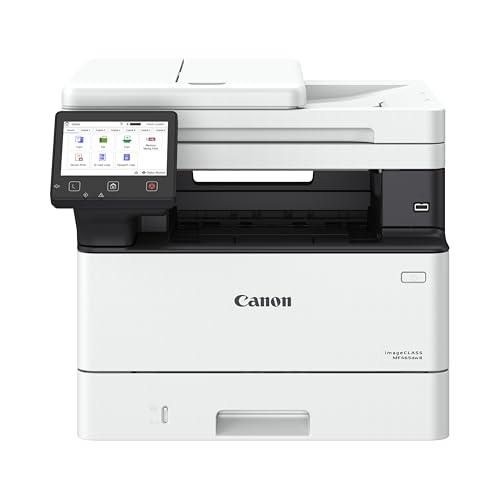
Selecting the ideal office workhorse requires balancing print speed, document feeding capacity, and long-term consumable expenses. For medium-sized teams needing rapid monochrome output and versatile 4-in-1 capability, the Canon imageCLASS MF465dw II delivers an exceptional 42 ppm engine paired with a clear 5-inch touchscreen interface. Its balance of rapid warm-up times and expandable paper handling makes it an outstanding all-around choice.
High-volume commercial settings with stringent security and throughput demands will find unmatched capability in the Brother MFC-L6810DW Enterprise Monochrome Laser. Delivering blazing 52 ppm speeds, an 80-page single-pass duplex feeder, and ultra high-yield 18,000-page replacement cartridges, this unit drives operating costs down while handling intense daily batch transmissions.
Smaller branch offices or individual desks requiring dedicated faxing on a modest budget should consider the Brother MFC-L2820DW Wireless Compact Monochrome. It combines a space-saving footprint, 36 ppm print speed, and intuitive cloud scanning shortcuts without demanding excessive desk real estate. If your office requires vivid presentations alongside fax communication, the Brother MFC-L8930CDW Business Color Laser provides professional full-color printing with robust enterprise security.
Maintaining a clean and orderly workstation extends beyond hardware selection to general office hygiene. Keeping scanner platen glass pristine with streak-free surface care prevents optical scan errors and ensures your outgoing faxes remain completely legible.
Frequently Asked Questions
Why are laser fax machines preferred over inkjet fax machines?
Laser machines use dry electrophotographic toner powder rather than liquid ink, producing crisp text that will not smear when exposed to moisture or highlighters. Laser engines also provide significantly faster print speeds, lower operating costs per page, and zero risk of clogged print heads during periods of inactivity.
How fast does a Super G3 laser fax machine transmit a document?
A Super G3 fax machine operating at 33.6 kbps transmits a standard black-and-white page in approximately three seconds under normal line conditions. Older G3 modems running at 14.4 kbps require around six to fifteen seconds per page, making Super G3 far more efficient for multi-page transmissions.
Can I connect a laser fax machine to a VoIP phone system?
Yes, modern laser fax units can operate over Voice over IP (VoIP) lines using an Analog Telephone Adapter (ATA) configured with the T.38 FoIP protocol. Lowering the modem transmission speed to 9.6 kbps or 14.4 kbps and disabling Error Correction Mode (ECM) can also help stabilize transmissions on jittery digital lines.
What security features protect confidential documents on Best Laser Fax Machines?
Top models incorporate secure PIN-release printing, encrypted memory storage, TLS network protocols, and NFC card authentication. These features hold incoming faxes securely in internal memory until the authorized recipient authenticates directly at the physical machine.
What is the benefit of single-pass duplex scanning on fax hardware?
Single-pass duplex scanning utilizes two separate optical sensor arrays to capture both sides of a document simultaneously as it moves through the feeder. This doubles scanning throughput, eliminates noisy mechanical page flipping, and significantly reduces the likelihood of paper jams.
How does digital fax forwarding work on multifunction laser printers?
Digital fax forwarding automatically converts incoming analog transmissions into electronic PDF or TIFF image files. The system then routes these files directly to designated email addresses, secure network folders, or cloud storage platforms, eliminating unnecessary paper printing.
What is the top-rated option among Best Laser Fax Machines in 2026 for high-volume offices?
For high-volume departmental workloads in 2026, models offering 50+ ppm print speeds, 80-sheet duplex ADFs, and ultra high-yield 18,000-page toner cartridges deliver the best balance of endurance and low operating expense. They provide the necessary duty cycles to handle thousands of pages monthly without strain.
How many speed dial numbers can modern laser fax devices store?
Most commercial laser fax machines store between 100 and 300 speed dial numbers in internal memory, with top enterprise models supporting up to 1,000 address book entries. Many units also integrate with corporate LDAP directories for effortless network-wide contact retrieval.
Can laser fax machines handle legal-sized documents and envelopes?
Yes, laser multifunction devices feature adjustable cassette guides and multipurpose bypass trays specifically designed for legal-sized (8.5 x 14 inch) paper, custom envelopes, and heavy cardstock. Their automatic document feeders and legal-size platen glass also support scanning legal documents directly.
Why is dual-band Wi-Fi important on modern office fax machines?
Dual-band Wi-Fi operates across both 2.4 GHz and 5 GHz frequency bands, allowing the printer to bypass congested 2.4 GHz office channels. This ensures faster data transfer, fewer dropped network connections, and smoother mobile printing from employee laptops and phones.





Write Your Review
No reviews yet. Be the first to share your experience!