Quick Answer: The Best Sponge Holders keep the sponge elevated, let water escape, and leave enough open area for air to circulate. Cisily Sponge Holder is the broadest overall choice for a countertop because it combines separate storage zones, a brush section, and a rotatable spout that directs drainage toward the sink. Choose OXO Stronghold or Toplife for compact suction mounting, OXO Stainless Steel for a freestanding ventilated cup, Umbra Sling for a flexible faucet or divider mount, simplehuman for a slim dual-mounted in-sink caddy, or Joseph Joseph when bottles and brushes need organized countertop storage.


Top Picks at a Glance
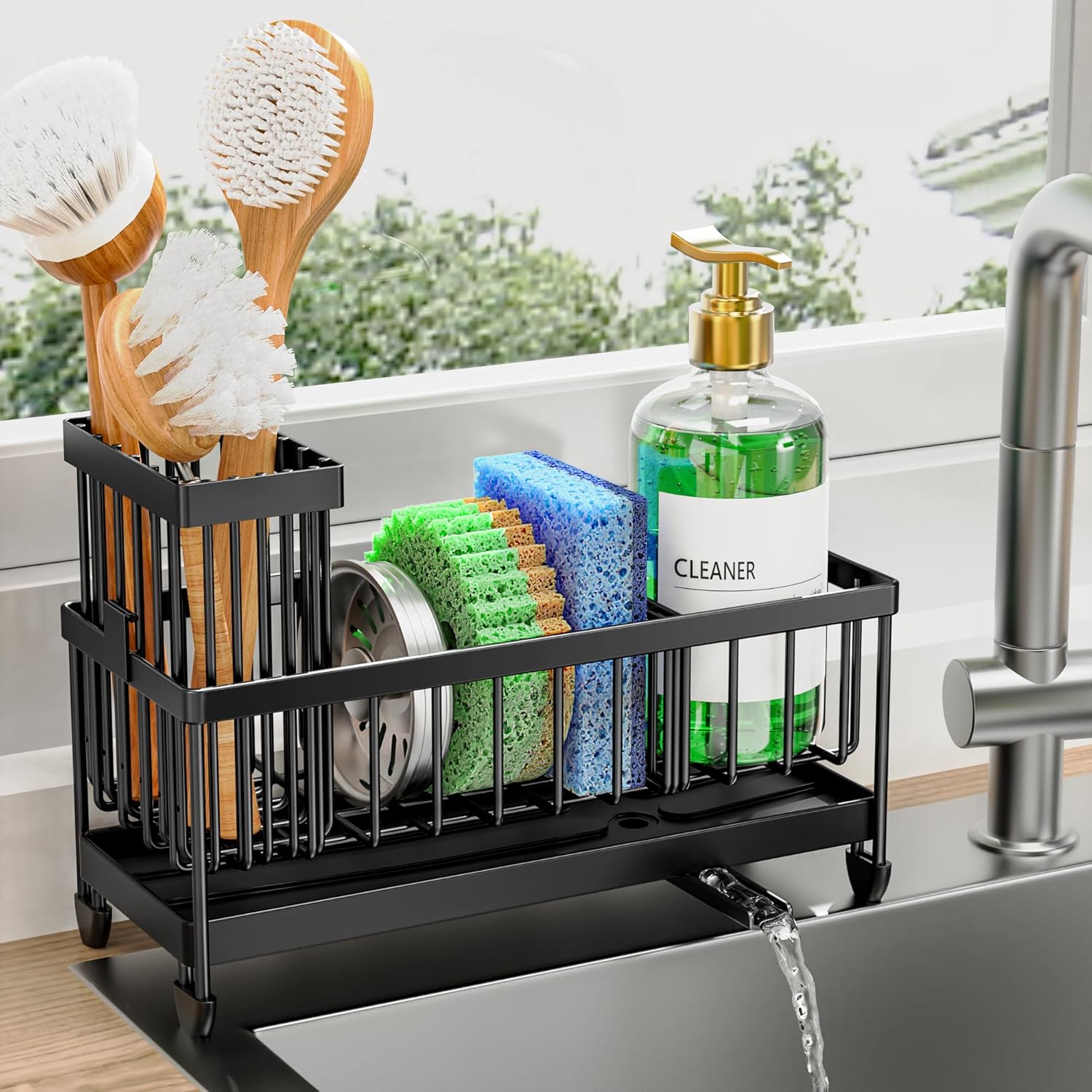
- Best Overall Countertop Caddy: Cisily Sponge Holder for Kitchen Sink, Sink Organizer with Brush Holder | Kitchen Countertop Organizers and Storage Essentials, Rustproof 304 Stainless Steel (Black, 9.25″) – separate tool zones and a rotatable drain spout in a 9.25-inch format.
- Best Lever Suction Holder: OXO Good Grips Stronghold Suction Sponge Holder – a removable basket, lever-activated suction cup, drainage slots, and dishwasher-safe listing.
- Best Simple Wire Suction Caddy: Toplife Sponge Holder for Kitchen Sink, Stainless Steel Suction Cup Sponge Caddy – Silver – an open 4.15-inch caddy with two installed and two spare suction cups.
- Best Freestanding Sponge Cup: OXO Good Grips Stainless Steel Sponge Holder – open sides, ventilation holes, a pour spout, raised feet, and parts that come apart for cleaning.
- Best Flexible Faucet Sling: Umbra Sling Flexible Sink Caddy, Elastic Non-Slip Sponge Holder, Black | Rubber material, perforated base for drainage, prevents moisture buildup, fits faucet necks, easy rinse clean – a flexible perforated design that forms around a faucet neck or sink divider without suction cups.
- Best Slim In-Sink Mount: simplehuman Slim Sink Caddy Sponge Holder, Brushed Stainless Steel, Silver – a narrow caddy using suction cups plus a wire ledge hanger for added support.
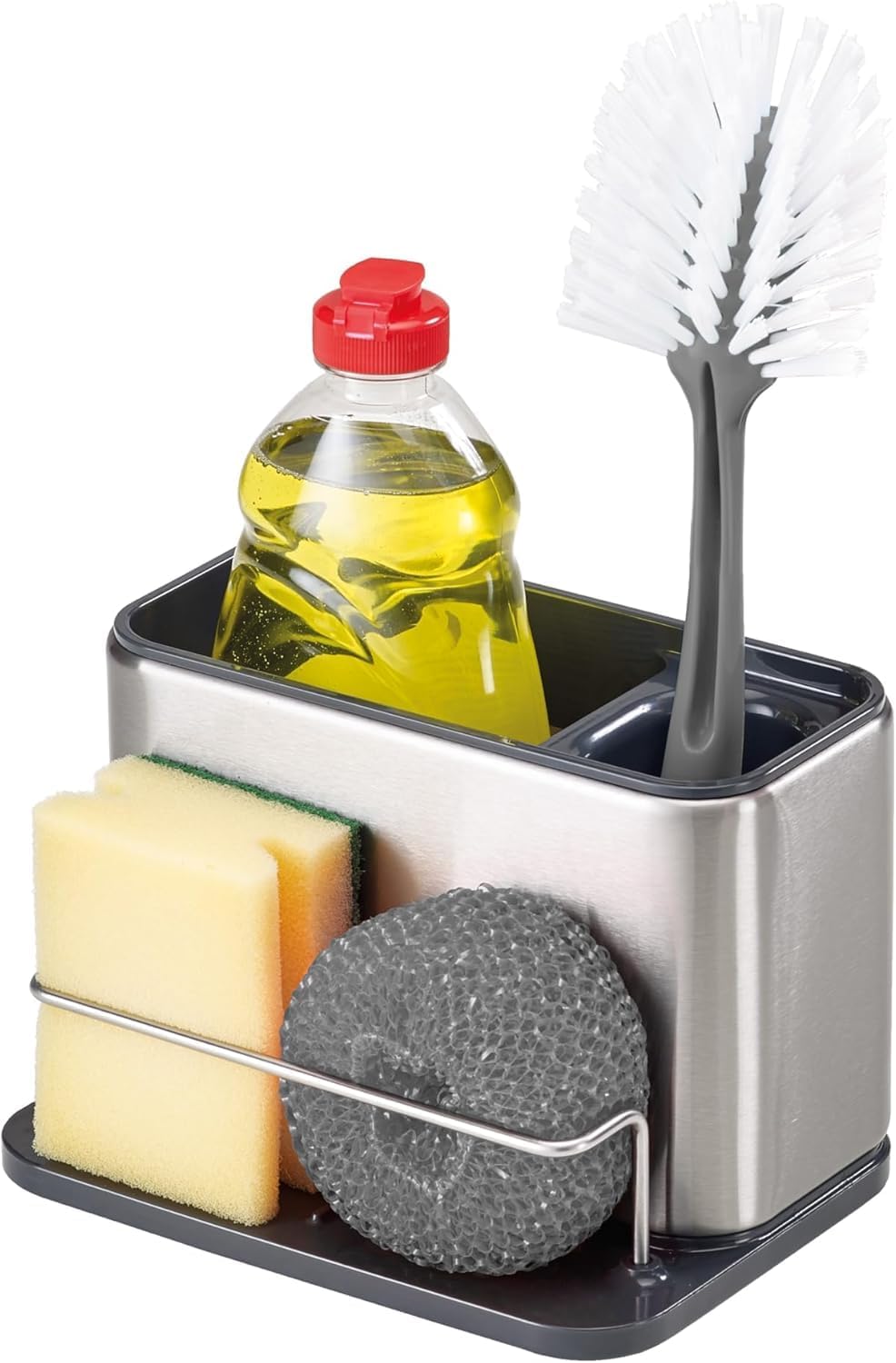
- Best Multi-Tool Countertop Organizer: Joseph Joseph Surface Stainless Steel Caddy Sink Area Organizer and Sponge Holder, Gray – separate bottle and brush sections, a sponge rail, sloped drainage, and a base that dismantles for hand washing.
The Best Sponge Holders manage water; they do not disinfect a sponge. Drainage and airflow can reduce the time a sponge remains saturated, but food particles, grease, soap residue, and microorganisms still require routine cleaning and timely sponge replacement.
What a Sponge Holder Actually Improves
A wet sponge placed flat on the sink rim or counter traps water across a large contact area. Elevating it exposes more surface to air and gives liquid a path downward. Open slots, wire rails, perforations, and raised feet support this basic function.
The holder also defines a home for the sponge, reducing counter clutter and keeping it away from food-preparation zones. Larger caddies organize a dish brush, scraper, stopper, and soap bottle, while a compact basket stores only the sponge or scrubber.
Good organization cannot correct poor cleaning habits. A caddy that collects gray water, food debris, and diluted soap becomes another surface to wash. The Best Sponge Holders make that task visible and easy instead of hiding residue in narrow seams or a deep nonremovable tray.
How to Choose the Best Sponge Holders
Select a Mounting Style First
Countertop caddies require no installation and move easily for cleaning. Cisily drains through a directional spout, OXO uses a compact cup with a pour spout, and Joseph Joseph uses a sloped base. These options work across more sink materials because they do not depend on adhesion, but they occupy counter space.
Suction models free the counter and keep drips inside the basin. OXO Stronghold uses a lever-activated cup, Toplife uses paired suction cups, and simplehuman combines suction with a ledge hanger. Suction generally needs a smooth, clean, nonporous surface. Toplife specifically excludes textured and porous surfaces.
Umbra Sling bends around a faucet neck or rests over a divider. It avoids suction and adhesive, but the faucet geometry must provide a stable position without blocking the handle, pull-down hose, sprayer, soap dispenser, or water stream. The Best Sponge Holders stay secure without making the sink harder to use.
Trace Every Drop of Water
Look beyond the word drainage. Water may fall directly into the basin, run through a spout, collect in a removable tray, or remain under the holder until it is poured out. The route should end in the sink without crossing wood, grout, laminate seams, stone joints, caulk, or the back edge of the counter.
Cisily’s spout rotates in three directions, allowing the user to aim it toward the basin. The OXO freestanding cup has a pour spout rather than continuous directed drainage. Joseph Joseph moves water down a sloped base and out of sight, which looks tidy but still requires dismantling and cleaning.
Check that the counter is level and the spout extends far enough over the sink edge. A drain feature that stops short can create a damp line beneath the caddy. The Best Sponge Holders provide a drainage path that remains reliable after the holder is loaded.
Measure the Sponge and the Sink
Measure the sponge when wet because it may swell. Include any thick scrubber, handled brush, sink stopper, scraper, and soap bottle that will share the holder. Overpacking closes ventilation gaps and makes small tools harder to remove without knocking everything over.
For an in-sink caddy, check basin depth, corner radius, divider thickness, drain location, and clearance for pots. OXO Stronghold’s basket can detach from its base to create more working space. simplehuman’s slim shape saves room, but its ledge hanger requires a compatible divider or rim position.
For a faucet sling, measure the faucet neck circumference and space between the neck and backsplash. For a countertop caddy, outline the footprint with removable tape before ordering. The Best Sponge Holders fit the real workspace rather than the empty sink shown in a product photo.
Match Capacity to Daily Tools
A single-sponge household benefits from a small open basket. Extra bottle compartments add cleaning work without adding useful storage. Conversely, a sponge-only holder becomes cluttered when the user also needs a dish wand, bottle brush, scraper, chain-mail scrubber, and drain stopper.
Cisily separates three storage areas and includes a taller brush section. Joseph Joseph provides bottle and brush compartments plus a rail for the sponge. Umbra Sling can hold brushes and scrubbers, but its flexible pocket is less structured than a divided countertop caddy.
Keep tools separated enough that air can reach them. A dripping dishcloth wrapped around a sponge delays drying for both. For tool selection beyond storage, compare dish brushes and choose only the pieces used regularly.
Prioritize Open Airflow
Wire frames provide large open areas, while perforated cups and slotted baskets balance support with airflow. OXO Stainless Steel uses open sides and ventilation holes. Toplife uses an open wire design. Umbra has generous cutouts plus a perforated base, and simplehuman lists numerous ventilation holes.
The sponge should not fit so tightly that its broad faces press against solid walls. Rotate or stand it on an edge when the holder design allows. Wring out excess water before storage; the holder should manage residual drips, not a sponge carrying a pool of water.
The Best Sponge Holders support faster drying through geometry, but room humidity, airflow, sponge thickness, and how thoroughly the user wrings it out remain important.
Check Material and Surface Protection
Stainless steel and corrosion-resistant claims do not mean a holder can never discolor. Water chemistry, salt, chlorine exposure, trapped residue, scratches, mixed metals, and damaged coating can affect appearance. Rinse deposits away and dry the holder according to its care instructions.
Flexible polymer avoids metal corrosion but can collect film, stains, or odor if not cleaned. Ceramic holders are heavier and decorative, yet can chip and may trap water depending on their opening. Adhesive models need finish compatibility and careful removal.
Inspect feet, wire ends, hooks, and suction hardware for sharp or rough contact points. Grit trapped under a caddy can scratch stainless steel, composite, porcelain, or countertop finishes. Lift the holder during cleaning rather than sliding it across the surface.
Make Cleaning Access Non-Negotiable
OXO Stronghold and OXO Stainless Steel are listed as dishwasher safe, while Joseph Joseph specifies dismantling and hand washing. Care methods differ, so follow the current product instructions rather than assuming every steel or polymer component tolerates dishwasher heat and detergent.
Removable trays and baskets expose hidden residue. Fixed dividers, rolled edges, suction bases, and narrow brush tubes need a small cleaning brush. If a holder cannot be reached with normal washing tools, residue will remain even when the visible exterior looks clean.
The Best Sponge Holders can be emptied, washed, rinsed, and dried without a complicated disassembly that discourages regular care.
Recommendations by Sink Layout
Small Single-Basin Sink
Start with the OXO Stronghold or Toplife suction holder if the basin wall is smooth. Mount it high enough to avoid standing dishwater but low enough that drips fall inside the sink. Confirm that a large pan can pass without striking the basket.
If suction will not adhere, use the OXO freestanding cup on the counter. Its narrow purpose prevents the storage footprint from expanding unnecessarily. The Best Sponge Holders for small sinks preserve washing volume first.
Double-Bowl Sink
simplehuman can use its ledge hanger on a compatible divider while the suction cups stabilize the caddy. Umbra Sling can also form around a divider. Measure thickness and rounded edges because a saddle that looks centered may lean when loaded.
A divider mount keeps the sponge over the basin but can interfere when moving cookware from one bowl to the other. Place it toward the rear if that preserves the main transfer path.
Textured or Composite Sink
A textured surface may prevent reliable suction. Toplife explicitly says its cups do not work on textured or porous surfaces. Choose a countertop caddy or a compatible faucet sling instead of adding unapproved adhesive.
Composite finishes can show mineral deposits or abrasion. Keep the base clean, follow the sink manufacturer’s chemical guidance, and avoid dragging metal feet over trapped grit.
Busy Family Kitchen
Cisily or Joseph Joseph provides more separation for bottles and brushes. Assign one compartment to each tool type and avoid using the caddy as a catchall for bottle caps, knives, food scraps, or wet cloths.
For choosing the cleaning material itself, see the guide to dish sponges. A larger caddy does not extend the useful life of a worn, torn, greasy, or foul-smelling sponge.
Sink With a Grid or Workstation Accessories
Check whether the holder collides with a bottom rack, roll-up mat, colander, cutting board, or sliding ledge accessory. A caddy mounted too low can catch on a sink grid during removal. Countertop placement may be simpler when the basin already has multiple accessories.
Setup and Maintenance Checklist
- Measure: Confirm the holder, sponge, tools, faucet, divider, and largest cookware can coexist.
- Clean the mounting area: Remove soap film and mineral deposits with a sink-safe method, then dry as required.
- Install: Activate suction, position the sling, or set the caddy exactly as the manufacturer directs.
- Test drainage: Add a small amount of clean water and confirm that every drip reaches the basin or removable tray.
- Load lightly: Start with the sponge and one essential brush before filling extra compartments.
- Wring first: Remove excess water from the sponge before placing it in the holder.
- Wash routinely: Empty residue, clean hidden seams and mounts, rinse, and let the holder dry.
- Inspect: Reseat loose suction cups and replace a holder with cracks, sharp edges, failing adhesive, or persistent corrosion.
Testing drainage before daily use helps the Best Sponge Holders avoid creating the counter puddle they were purchased to prevent.
Sponge Hygiene and Cross-Contamination
Use separate tools for dishes and for contaminated surfaces such as raw-meat spills, floors, pet bowls, drains, or trash areas. Do not store a drain-cleaning brush against the dish sponge. Color coding or physically separate storage reduces accidental swapping.
Rinse food particles from the sponge, wring it thoroughly, and place it where air reaches more than one face. Clean the caddy whenever residue, slime, odor, or standing water appears. Replace a sponge when it remains odorous after proper cleaning, breaks apart, loses structure, or has been used on contamination that should not return to dishes.
No holder sterilizes its contents. The Best Sponge Holders improve storage conditions while users still control cleaning method, replacement timing, handwashing, and separation between tasks.
Common Mistakes and Trade-Offs
- Mounting over standing water: The sponge and basket are repeatedly submerged when the sink fills.
- Using suction on texture: Air leaks under the cup and the loaded holder falls without warning.
- Ignoring the drainage endpoint: A short spout sends water beneath the caddy or into a counter seam.
- Overloading compartments: Brushes block airflow, tip the holder, and make cleaning more difficult.
- Leaving soap in the tray: Diluted detergent and food residue form a film that must be washed away.
- Assuming rustproof means maintenance-free: Deposits and contamination still need removal from metal surfaces.
- Hiding tools below the sink while wet: Enclosed storage limits airflow. Use a dry sink base organizer for appropriate supplies, not a dripping sponge.
How We Tested and Evaluated
We evaluated verified Amazon listing information rather than claiming hands-on laboratory testing. The selection covers countertop caddies, suction mounts, a flexible faucet sling, and a dual-supported in-sink holder. We compared dimensions, drainage path, ventilation, listed material, mounting requirements, compartment layout, removal, and care instructions.
We gave more weight to a clear route for water and accessible cleaning than to decorative style. The Best Sponge Holders also had to represent a defined sink layout or tool load without implying that storage alone sanitizes a sponge.
Frequently Asked Questions
What Are the Best Sponge Holders for Fast Drying?
Choose an open wire, slotted, or perforated design that holds the sponge without pressing its broad faces against solid walls. OXO Stainless Steel, Toplife, Umbra Sling, and simplehuman all emphasize ventilation. Wringing the sponge and maintaining room airflow remain essential.
Why Does My Suction Sponge Holder Keep Falling?
The surface may be textured, porous, curved, dirty, wet in the wrong way, or coated with soap and mineral film. The cup may also be old or overloaded. Clean and install it according to the manufacturer. If the sink is incompatible, switch to a countertop, divider, or faucet-mounted design.
Is Stainless Steel Better Than Plastic or Rubber?
Not universally. Stainless steel can be rigid, open, and durable, while a flexible polymer can fit curved faucet and divider shapes without metal contact. Compare drainage, cleanability, finish quality, and compatibility rather than material name alone.
Should the Holder Sit Inside or Outside the Sink?
Inside placement directs drips into the basin and frees the counter, but it uses washing space and receives more splash. Outside placement is easier to access and can hold more tools, but it needs a reliable tray or spout. Choose based on basin size and drainage.
How Often Should I Clean a Sponge Holder?
Clean it whenever residue, odor, slime, mineral deposits, or standing water appear, and include it in the regular sink-cleaning routine. Follow its dishwasher or hand-wash instructions. A busy kitchen or heavily soiled sponge may require more frequent care.
Can a Sponge Holder Prevent Bacteria?
It can improve drainage and drying conditions, but it does not disinfect, sterilize, or guarantee prevention. Clean and replace sponges appropriately, separate tools by task, wash hands, and clean the holder itself.
Final Decision
Cisily Sponge Holder is the strongest overall countertop option when a household needs sponge, bottle, and brush storage with directed drainage. OXO Stronghold and Toplife suit smooth basin walls, OXO Stainless Steel keeps a single sponge ventilated on the counter, Umbra Sling avoids suction, simplehuman saves in-sink space, and Joseph Joseph organizes a broader washing setup.
The Best Sponge Holders fit the sink, carry only the necessary tools, drain to a controlled location, and come apart easily enough to stay clean.