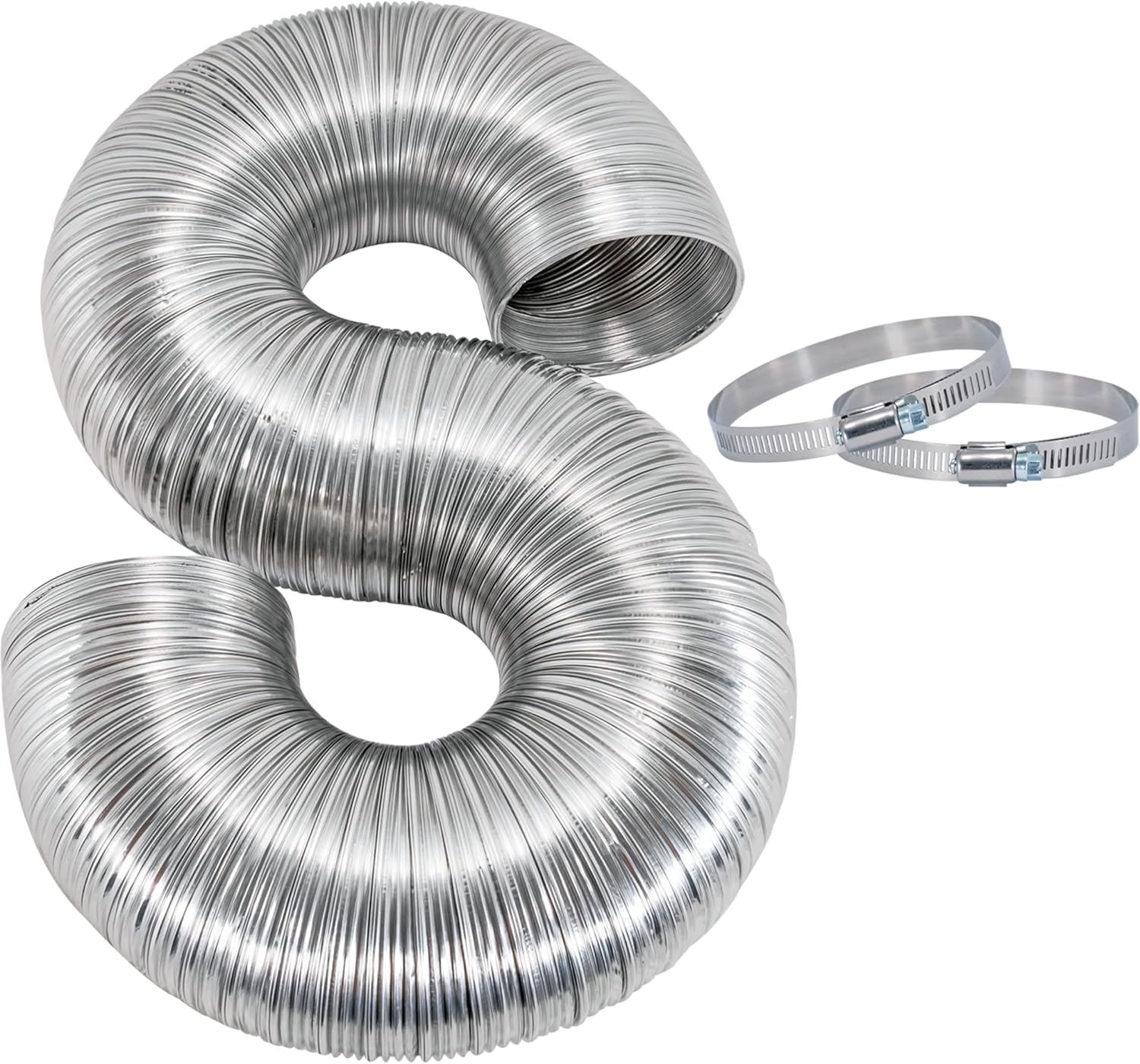
Quick Answer: The Best Dryer Vent Hoses are approved metal transition ducts sized to the dryer and wall outlet, kept as short and straight as practical, secured mechanically, and left exposed for inspection. Eastman ArmorFlex 8 Foot is the strongest overall option in this group because its verified listing combines semi-rigid aluminum, two stainless-steel clamps, shape retention, and enough supplied length for varied offsets. Use only the length needed. Choose Deflecto for a short two-foot connection, Hon&Guan or HOOMESUN for five-foot kits, or the Hon&Guan magnetic coupling for compatible tight-space access.


Top Picks at a Glance
These Best Dryer Vent Hoses are semi-rigid aluminum transition products in several lengths and connector formats. Flame, temperature, airflow, seal, gas-dryer, and safety statements are manufacturer claims; local code, dryer instructions, and the authority having jurisdiction determine whether an installation is acceptable.
- Best Overall: Eastman 8 Foot ArmorFlex Dryer Vent, Flexible Aluminum Duct with Clamps, Semi-Rigid, 69028 – an eight-foot semi-rigid aluminum duct with two stainless-steel clamps and listed shape retention.
- Best Short Connection: Deflecto Aluminum Duct with Connectors, Semi Ridgid, Flexible , 4″ x 2′, Silver (AM42) – a two-foot, 30-gauge aluminum connector with four-inch diameter and listed 284-degree-Fahrenheit maximum temperature.
- Best Five-Foot Kit: Hon&Guan 4 Inch Semi-Rigid Dryer Vent Hose for Improved Airflow, 5Feet | Semi-rigid design prevents kinks, Smooth Inner, High Airflow Efficiency,with 2 Hose Clamps, Aluminum Foil Tape Sealing – a five-foot aluminum duct with two clamps and foil tape.
- Best Alternative Five-Foot Kit: HOOMESUN 4 Inch 5FT Semi Rigid Dryer Duct, Vent Hose for Improved Airflow | Semi-rigid design holds shape, Smooth Inner, High Airflow Efficiency, with 2 Hose Clamps, Aluminum Foil Tape Sealing – a semi-rigid aluminum kit with two clamps and supplied aluminum foil tape.
- Best Magnetic Access: Hon&Guan Magnetic Dryer Vent Coupling Connector Kit DV180 with 4” 2.6FT Semi Rigid Dryer Vent Hose for Tight Space & Aluminum Foil Tape,2 Clamps(Gray) – a 2.6-foot semi-rigid duct with magnetic quick-connect coupling, sealing ring, tape, and clamps.
How to Choose the Best Dryer Vent Hoses
The Best Dryer Vent Hoses begin with the dryer manual, local mechanical and fire code, and actual connection geometry. Product-page compatibility is not enough. Confirm that semi-rigid transition duct is permitted, where it may be used, and the maximum length.
Confirm Diameter and Connector Geometry
The selected products use a nominal four-inch diameter, which is common but not universal. Measure and identify the dryer’s exhaust collar and the fixed wall or floor duct. Check whether each end is crimped, plain, male, female, oval, recessed, or fitted with an elbow.
The Best Dryer Vent Hoses slide over or into connectors exactly as the approved system requires. Do not slit a duct, crush it into an oval, stack incompatible adapters, or reduce the diameter simply to make a connection fit.
Measure the Installed Route
Measure center-to-center offset, vertical difference, and distance with the dryer in its final leveled position. Include a safe service path, but avoid extra loops. An eight-foot product should not remain fully extended when a two-foot run can connect without strain.
Deflecto suits a short aligned route. The two five-foot kits allow more offset. The magnetic kit lists coverage for zero-to-eight-inch centerline offsets with a 2.6-foot duct. Eastman’s eight feet offer flexibility but require careful trimming or routing according to instructions and code.
Use Approved Metal Transition Material
Semi-rigid aluminum holds shape better than many thin foil or plastic products and can preserve a smoother path when installed correctly. That does not make every aluminum hose automatically compliant. Gauge, listing, connector, length, use location, and dryer requirements matter.
The Best Dryer Vent Hoses avoid vinyl and plastic where prohibited. Do not rely solely on “fire resistant,” “Class 0,” or temperature wording. Those claims do not certify the clamps, wall duct, exterior termination, installation, or surrounding clearances.
Transition Duct Is Not Permanent Wall Duct
A transition duct connects the appliance to the fixed exhaust system and remains accessible behind or beside the dryer. It should not disappear inside a wall, ceiling, floor, cabinet, or other concealed space when code prohibits that use.
Permanent concealed routing generally requires smooth rigid metal duct installed to applicable rules, with approved joints and equivalent-length limits. The transition hose cannot correct an undersized, disconnected, excessively long, crushed, or contaminated wall duct.
The full route ends at an approved exterior termination. Compare dryer vent closures for that endpoint, but do not add screens or restrictive accessories against code. A dryer booster fan, where permitted, is not a substitute for correct duct design or cleaning.
Bends, Compression, and Airflow
Every bend and compressed section adds resistance and a place where lint can collect. Use broad gentle curves instead of folding the aluminum sharply. A listing that says a hose can make a 90-degree bend does not mean a creased right angle has good airflow.
The Best Dryer Vent Hoses retain a round cross-section when the dryer is moved into place. Watch the connection from the side if possible, move the appliance slowly, and stop before it presses the duct against the wall.
Do not stretch semi-rigid aluminum to its limit and then bend it repeatedly. The magnetic-kit listing notes that sharp bending or pressure can indent aluminum. Dents, tears, flattened ribs, and punctures require evaluation and often replacement rather than reshaping by force.
Clamps, Tape, and Magnetic Couplings
Mechanical attachment keeps a duct on its collar. The selected kits include clamps, and some add aluminum foil tape. Use only the clamp, connector, and seal method approved by the dryer, duct, and code. Tape should not replace a required mechanical connection.
Ordinary cloth-backed “duct tape” can dry, loosen, and is not automatically approved for dryer exhaust. Use listed foil tape only where permitted. Avoid screws or fasteners that project into the airflow when prohibited, because protrusions can catch lint.
The Best Dryer Vent Hoses with magnetic couplings make access easier only when the two halves align, seat fully, seal, and resist appliance vibration. Test the empty dryer position before operation and inspect for gaps, lint leakage, heat leakage, or accidental disconnection.
Installation and Moving the Dryer
Disconnect electrical power according to the appliance instructions. Gas dryers add fuel-line and shutoff requirements; do not pull, twist, disconnect, or reposition gas equipment without appropriate qualification and authorization.
Clean and inspect both collars. Fit the transition duct without sharp edges contacting wires, flooring, or the power cord. Tighten approved clamps evenly without cutting the aluminum. Seal only as directed.
Move the dryer into position slowly while another person observes the duct when safe. Level the appliance, preserve service clearance, and ensure the Best Dryer Vent Hoses do not carry the weight of the dryer or pull sideways on the wall collar.
- Verify power and gas safety: Follow appliance and professional requirements before movement.
- Dry-fit first: Confirm diameter, offset, and length before tightening.
- Form gentle curves: Preserve a round interior without excess loops.
- Secure both ends: Use approved collars, clamps, couplings, and tape.
- Inspect after positioning: Check for crushing, pulling, gaps, and sharp contact.
Inspection and Cleaning
Inspect the accessible transition at installation and periodically according to the dryer and code guidance. Look for lint around joints, loose clamps, heat discoloration, corrosion, punctures, tears, crushed ribs, magnetic separation, and movement at the wall collar.
Disconnect and clean only by an approved method. Short transition ducts may be removable for inspection, but the dryer must be powered down and gas connections handled correctly. Do not insert a tool that can puncture thin aluminum.
The best dryer lint brushes address accessible trap areas, not every transition or concealed duct. Keep clamps and service tools organized without blocking airflow or access; see broader laundry room organizers.
Common Mistakes and Limitations
Even the Best Dryer Vent Hoses become restrictive or unsafe when length, bends, connectors, and appliance clearance are handled poorly.
- Buying by maximum length: Excess duct adds bends, surface area, and crushing risk.
- Using the wrong diameter: Reduced or improvised connections restrict airflow.
- Concealing transition duct: Flexible appliance connectors must remain in approved accessible locations.
- Making sharp bends: Creases and flattening collect lint and increase resistance.
- Using tape alone: A seal does not replace required mechanical attachment.
- Driving screws into airflow: Protruding fasteners can catch lint when prohibited.
- Pushing the dryer blindly: The appliance can crush or disconnect the hose.
- Moving a gas dryer casually: Fuel connections require correct professional handling.
The Best Dryer Vent Hoses provide an accessible appliance transition, but they cannot make a noncompliant route safe, repair fixed ductwork, guarantee airflow, or replace installation inspection.
How We Tested and Evaluated
We did not conduct independent flame, temperature, airflow, leakage, lint, vibration, magnetic-retention, crush, puncture, gas, code, or lifecycle tests. We evaluated Crawlbase-captured Amazon pages for exact identity, diameter, length, material, clamps, tape, connectors, coupling features, bends, and listing claims.
Our assessment of the Best Dryer Vent Hoses prioritizes approved semi-rigid metal, shortest practical length, gentle geometry, mechanical security, access, appliance movement, and inspection. Product claims do not establish local compliance.
Buying Checklist
Use this checklist to choose the Best Dryer Vent Hoses for the dryer, fixed duct, and installation rules.
- Read the dryer installation manual and local code requirements.
- Confirm nominal diameter and both connector shapes.
- Measure the installed offset and choose the shortest practical length.
- Use approved semi-rigid metal transition material.
- Keep transition duct exposed and out of concealed construction.
- Plan broad bends without compression, loops, or sharp creases.
- Use approved clamps, collars, couplings, and foil tape.
- Preserve service access without loading or pulling the duct.
- Handle gas dryers and appliance movement with proper qualification.
- Inspect for leakage, lint, dents, tears, loose joints, and crushing.
Frequently Asked Questions
Are the Best Dryer Vent Hoses code compliant?
Compliance depends on the exact product listing, dryer instructions, installation, location, length, connectors, and local rules. Semi-rigid aluminum is not automatically approved everywhere.
How long should a dryer hose be?
Use the shortest practical approved transition that reaches without strain and allows safe service. Do not leave unused length coiled behind the appliance.
Can semi-rigid hose run inside a wall?
Transition duct generally must remain exposed and accessible. Concealed exhaust routing typically requires smooth rigid metal installed to code. Confirm local requirements.
Can I use regular duct tape?
Do not assume cloth-backed duct tape is approved. Use mechanical connections and listed foil tape only where the dryer and code permit them.
Why is the dryer still hot or slow?
The transition may be crushed, but the fixed duct, exterior termination, load, airflow, or appliance may also be at fault. Stop unsafe operation and obtain qualified diagnosis.
When should a professional install the connection?
Use qualified help for gas dryers, uncertain code, damaged collars, concealed or complex routes, inaccessible outlets, repeated disconnections, or any work beyond safe appliance positioning.
Final Decision
Eastman ArmorFlex provides the broadest semi-rigid length and included clamps. Deflecto suits a short connection, Hon&Guan and HOOMESUN cover typical five-foot offsets, and the Hon&Guan magnetic kit supports compatible quick access in tight spaces.
The Best Dryer Vent Hoses are not the longest or most flexible options. They are the shortest approved metal transitions that fit without strain, preserve a round path, remain mechanically secured and accessible, and comply with the dryer manual and local code.