

Best Wall Clocks Quick Answer: The AKCISOT 12 Inch Wall Clock is the most balanced simple analog choice in this group. Its verified listing combines large Arabic numerals, a clean black frame, a quiet sweep movement, battery operation, and two included hooks. Among the Best Wall Clocks, it favors everyday readability and low noise over atomic synchronization, premium frame materials, or oversized decorative impact.


Top Picks: Best Wall Clocks at a Glance
These choices cover simple silent analog displays, two atomic formats, solid-wood frames, an oversized Roman-numeral design, and a bright modern clock with slight ticking. Choose by viewing distance and room conditions before choosing by color alone.
- Best Simple Silent Analog: AKCISOT 12 Inch Wall Clock – a round black analog clock with large numerals, a quiet sweep movement, battery operation, and two hooks.
- Best Classic Atomic Design: Bulova Atomic Time 2 Wall Clock C5004 – a 12.4-inch analog clock with warm brown cherry wooden frame, gold-tone bezel, atomic synchronization, automatic daylight-saving adjustment, and one-AA operation.
- Best Atomic Battery Life: La Crosse Technology WT-3129B Atomic Wall Clock – a 12-inch black analog clock that receives the WWVB signal, supports four continental U.S. time-zone settings, and lists up to five years from three quality AA batteries.
- Best Solid-Wood Retro Style: Kesin 14 Inch Wood Wall Clock – a brown solid-wood frame with large Arabic numerals, glass lens, quiet sweep movement, rear slot, supplied hook, and one-AA requirement.
- Best Oversized Accent: Vantic 24 Inch Large Wall Clock – a 23.6-inch farmhouse-style metal clock with Roman numerals, silent listing language, rear mounting slots, and supplied traceless nails.
- Best Traditional Oak Frame: Seiko Quiet Sweep Oak Wall Clock – a 13-inch dark-brown solid-oak clock with Arabic numerals, glass cover, quiet sweep second hand, included AA battery, and one-year limited warranty.
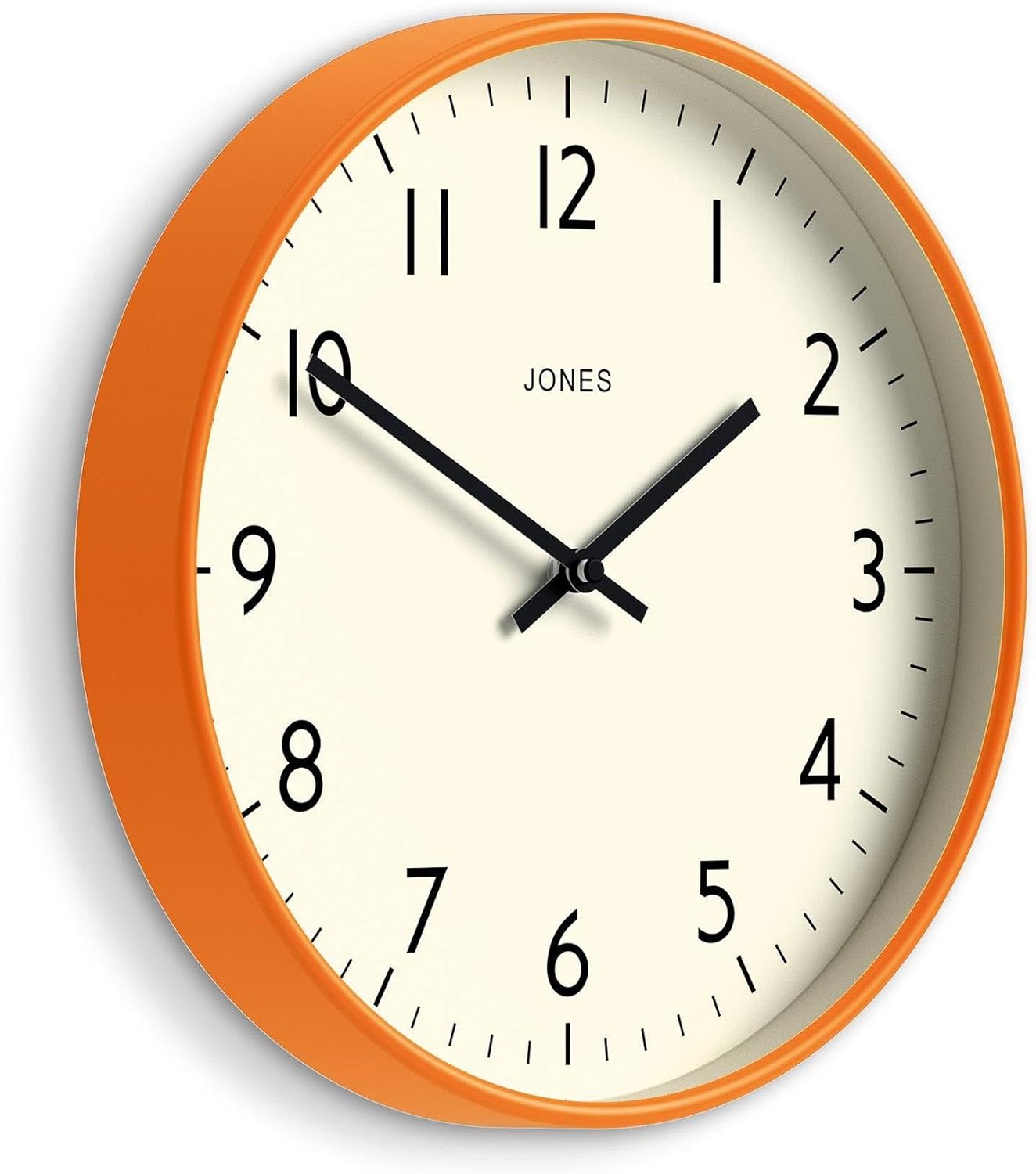
- Best Color-Forward Modern Design: JONES CLOCKS Studio Clock – a 12-inch orange acrylic clock with glass lens, easy-read numerals, quartz mechanism, slight ticking, and one-AA requirement.
Start With the Room and Viewing Distance
A kitchen clock may be read while someone moves between counters. An office clock may sit across a desk, while a classroom clock must remain legible from the back row. Estimate the longest normal viewing distance and test the proposed location before ordering.
Use a paper circle or painter’s tape to mark the advertised diameter on the wall. Then stand at the intended viewing points and consider whether the numeral size, hand contrast, and dial color will remain clear.
The Best Wall Clocks do not merely fit an empty spot. They remain visible without forcing the reader to move closer, and they avoid being hidden by doors, cabinets, plants, or tall furniture.
Dial Size, Contrast, and Readability
Diameter alone does not guarantee readability. Large black Arabic numerals on a pale dial usually read more quickly than thin decorative hands against a busy face. AKCISOT, Kesin, Seiko, and the two atomic clocks emphasize clear numerals.
Roman numerals give the Vantic a decorative look, but they may take longer to interpret for some viewers. The JONES orange case adds a strong color accent while retaining conventional easy-read numbers.
Glass lenses protect the face, yet windows and lamps can create glare. Before drilling, hold a reflective object at the proposed height and inspect it at different times of day. The Best Wall Clocks balance dial scale, contrast, and sightline rather than relying on diameter alone.
Silent Sweep Versus Audible Ticking
A silent-sweep movement moves the second hand continuously or in very small increments, reducing the sharp once-per-second sound associated with many quartz clocks. AKCISOT, Kesin, and Seiko use quiet or silent-sweep listing language.
Silent does not prove that every person will hear absolutely nothing. Motor hum, vibration against a wall, battery condition, and a quiet room can make subtle movement noise noticeable. Bedrooms, study rooms, recording areas, and therapy offices deserve the strictest sound consideration.
The JONES listing explicitly describes slight ticking. That may be acceptable in a kitchen or active office but less suitable beside a bed. When comparing the Best Wall Clocks, treat movement sound as a room-specific requirement, not a universal quality ranking.
Atomic Timekeeping and Signal Limits
Atomic wall clocks contain a radio receiver that listens for a time signal rather than housing an atomic reference themselves. The La Crosse WT-3129B is designed to synchronize with the WWVB transmission from Fort Collins, Colorado. It provides PT, MT, CT, and ET settings.
Bulova C5004 also lists automatic synchronization and daylight-saving adjustment. Reception can vary with distance, building materials, electronic interference, weather, location inside the building, and the direction the clock faces during setup.
An atomic model may need an overnight reception window, correct time-zone selection, and placement away from electronics. Unsupported regions or unusual local daylight-saving rules can still require manual intervention. The Best Wall Clocks with atomic features are convenient when their signal and zone assumptions match the installation.
Match Clock Scale to the Wall
A 12-inch clock works as a practical time display over a desk, counter, doorway, or compact wall section. A 13- or 14-inch wood clock carries more visual weight without becoming the primary decorative object.
The Vantic is listed at 23.6 inches and is intended to behave as wall decor as well as a clock. Oversized open-face hands need surrounding clearance, and the clock should not appear squeezed between trim, shelving, or artwork.
Mark the outer diameter and the visual center. A large clock may need to align with a sofa, console, dining table, or architectural feature rather than the mathematical center of the entire wall. The Best Wall Clocks look proportionate from the main seating and standing positions.
Frame and Lens Materials
AKCISOT favors a simple lightweight utility format. The JONES Studio uses a matte acrylic case and glass lens. Acrylic enables saturated color and a clean cylindrical shape, though it does not imitate natural wood.
Kesin lists a handcrafted solid-wood frame, while Seiko uses a dark-brown solid-oak case. Natural grain and finish variation are part of the appeal. Bulova combines a warm brown cherry wooden frame with a polished gold-tone bezel.
Vantic uses metal in an open decorative format. Metal and wood can require stronger mounting than a compact plastic or acrylic clock. Verify actual delivered weight and wall construction instead of choosing an anchor from appearance alone.
Installation and Hand Clearance
Locate studs, pipes, and electrical wiring before drilling. Drywall anchors, masonry fasteners, picture hooks, and screws have different load ratings and wall requirements. A supplied hook or traceless nail is useful only when it suits the wall material and clock weight.
Kesin includes a hook and a rear hanging slot. Vantic uses rear mounting slots and includes traceless nails. For an oversized open clock, confirm that the frame sits flat and that exposed hands do not contact the wall, frame, or each other.
The Vantic listing specifically instructs users to position the hour and minute hands horizontally during adjustment to help prevent collision. Move clock hands only according to the supplied instructions, preferably with the rear setting control rather than forcing them from the front.
Install the Best Wall Clocks high enough for visibility but low enough for safe battery replacement. Avoid a location that requires leaning over stairs, appliances, or furniture every time the clock needs attention.
Battery Requirements and Initial Setup
AKCISOT is battery powered. Bulova, Kesin, Seiko, and JONES specify one AA battery; the Seiko listing includes one, while the other listed examples state or imply a separate battery requirement. Follow the exact polarity and battery-type directions included with the delivered clock.
La Crosse uses three AA batteries and lists up to five years with a quality set. Long battery-life claims depend on battery quality, reception behavior, temperature, and movement condition.
After installation, compare the clock against a reliable time source for several days. If it loses time, stops, or behaves irregularly, inspect battery contacts, confirm hand clearance, install a fresh compatible battery, and repeat the setup procedure before assuming the movement has failed.
Room-Specific Placement
In kitchens, keep the clock away from steam, grease, direct heat, and cabinet doors. An easy-clean frame and high-contrast dial are usually more useful than intricate open details near cooking areas.
Bedrooms and quiet offices benefit from sweep movements. Classrooms and shared workspaces prioritize large numerals, broad sightlines, and secure mounting. Living rooms can support wood, metal, or strong color when the clock also serves as decor.
Do not place an indoor-only clock outdoors, in a shower zone, or in a persistently damp room unless its instructions explicitly support that environment. All seven selected listings describe indoor use. The Best Wall Clocks last longer when humidity, sunlight, heat, and accidental impact are controlled.
Coordinate the Clock With Wall Decor
A clock does not need to match every finish, but it should relate to at least one nearby element: wood tone, metal color, frame shape, or accent color. Compare best picture frames when coordinating black, wood, or metallic borders.
Mirrors compete for visual scale and reflection. Review best wall mirrors before placing a large clock on the same wall, especially where reflected glare can cross the dial.
A mixed arrangement requires consistent spacing and a clear focal point. See best gallery wall kits for planning repeated shapes and margins. Nearby best accent lamps can improve evening readability, but position the light so it does not reflect directly in a glass lens.
How We Tested and Evaluated
We evaluated verified Amazon listing information rather than installing, timing, or listening to these clocks hands-on. Products were compared by diameter, display, numeral style, frame material, lens, movement description, sound language, power source, atomic features, time-zone support, mounting information, and setup cautions.
Atomic convenience was separated from quartz movement quality, and silent listing language was not treated as proof of zero audible sound. Readability was assessed from stated size, contrast, and numeral design rather than a controlled distance test.
The Best Wall Clocks evaluation prioritizes legibility, appropriate scale, realistic sound expectations, secure installation, and maintainable battery access. Long-term accuracy and durability still depend on the delivered unit, environment, setup, and care.
Common Mistakes With Best Wall Clocks
- Choosing by diameter alone: Thin hands and low contrast can remain hard to read.
- Assuming silent means inaudible: Quiet rooms can reveal subtle movement or vibration.
- Expecting atomic reception everywhere: Walls, electronics, geography, and zone support matter.
- Ignoring lens glare: A bright window can hide the dial for hours.
- Using the supplied hook on every wall: Fasteners must match the wall and load.
- Forcing hands from the front: Bent or colliding hands can stop the movement.
- Mounting too high: Battery changes become unsafe and inconvenient.
- Putting an indoor clock in damp conditions: Moisture can affect the face and mechanism.
- Making a 12-inch clock fill an oversized wall: Functional size and decorative scale differ.
- Discarding setup instructions: Atomic modes and time-zone switches vary.
Best Wall Clocks Buying Checklist
- Measure the available wall and mark the full clock diameter.
- Test readability from the farthest normal viewing point.
- Compare Arabic numerals, Roman numerals, hands, and dial contrast.
- Choose quiet sweep, slight ticking, or atomic operation by room.
- Confirm atomic region, time-zone choices, and signal expectations.
- Check frame material, lens reflection, and approximate visual weight.
- Match the mounting hardware to studs, drywall, masonry, or another surface.
- Leave safe access for setup and battery replacement.
- Verify battery size, quantity, inclusion, and recommended chemistry.
- Review selected size, color, operating instructions, warranty, and return terms.
Cleaning and Maintenance
Remove dust with a soft dry microfiber cloth. Support the clock while cleaning rather than pressing it against the hook. Use lens cleaner only when the manufacturer’s material guidance permits it, and apply liquid to the cloth instead of spraying the clock.
Inspect wood away from excess moisture and avoid abrasive cleaners on acrylic, plated bezels, paint, or metal finishes. For an open-face clock, clean around exposed hands gently without bending them.
Replace weak batteries promptly and clean contacts only with an approved dry method. Recheck mounting hardware, time accuracy, and hand clearance after battery changes. The Best Wall Clocks remain dependable when their movement, mounting point, and dial stay clean and undisturbed.
Frequently Asked Questions
What size wall clock is easiest to read?
There is no single size for every room. Twelve to 14 inches can suit many kitchens and offices, while longer sightlines may need larger numerals or a larger dial. Contrast and hand design matter as much as diameter.
Are silent wall clocks completely silent?
Quiet-sweep movements reduce distinct ticking, but a sensitive listener may still notice faint motor sound or wall vibration. Evaluate the room’s background noise and distance from the bed or desk.
How does an atomic wall clock set itself?
It receives a radio time signal, applies the selected time zone, and moves the hands to the calculated local time. Reception may require correct placement and an overnight synchronization period.
Why is my atomic clock showing the wrong hour?
Check the time-zone selector, daylight-saving setting, battery condition, and synchronization status. A clock can display accurate minutes but the wrong local hour when its zone is incorrect.
Where should a wall clock be mounted?
Choose a clear sightline away from glare, steam, direct heat, moving doors, and impact. Keep it reachable enough for safe setup and battery changes.
Which are the Best Wall Clocks for a quiet room?
AKCISOT, Kesin, and Seiko use silent or quiet-sweep listing language. Seiko adds a solid-oak case, Kesin provides a 14-inch wood frame, and AKCISOT emphasizes a simple easy-read dial. Individual sound sensitivity still varies.
Final Decision: Best Wall Clocks
Choose AKCISOT for simple quiet readability, Bulova for atomic time in a warm wood design, or La Crosse for four continental U.S. zone settings and a stated long battery-life target.
Select Kesin for a larger solid-wood retro frame, Vantic for an oversized Roman-numeral accent, Seiko for traditional oak and quiet sweep, or JONES for modern orange color where slight ticking is acceptable.
Before choosing the Best Wall Clocks, test the dial size on the wall, evaluate glare and sound, confirm battery and signal requirements, and use mounting hardware suited to the actual surface. A clock is successful when it can be read easily, maintained safely, and trusted without dominating the room unintentionally.