
A smokeless indoor grill promises the sizzle and char of outdoor barbecue without the smoke alarms, the propane tank, or the weather forecast checking. But “smokeless” doesn’t mean every model performs the same way on your countertop, and choosing the wrong one can leave you with a bulky appliance that either smokes anyway or can’t sear a steak properly. If you’re trying to slot a smokeless indoor grill into an already crowded countertop cooking lineup, this guide walks you through exactly how to evaluate your options step by step.

Why Smokeless Indoor Grills Belong in a Countertop Lineup
Countertop cooking has expanded well beyond the microwave and toaster. Air fryers, rotisserie ovens, and indoor grills now share space on many kitchen counters because each one solves a different craving: crisp fried texture, slow-roasted flavor, or that grilled char you’d otherwise need a backyard for. A smokeless indoor grill fills the “grilled” gap year-round, letting you cook burgers, chicken thighs, fish fillets, and vegetables with visible sear marks in minutes, indoors, in any season, without firing up charcoal or propane.
The challenge is that “smokeless” is a marketing term applied loosely across the category. Some grills genuinely minimize smoke through clever drip-tray and fan design; others just reduce it slightly compared to an open flame. Knowing what actually controls smoke output – and matching that to how you cook – is the real decision point.
Step 1: Define How You’ll Actually Use It
Before comparing specs, get specific about your cooking habits. Are you grilling for one or two people on weeknights, or feeding a family of five on weekends? Do you want quick weeknight proteins, or do you also want to sear vegetables and reheat leftovers with grill marks? Your answer determines almost every other choice below, from surface area to wattage to price point.
- Weeknight solo or couple cooking: A compact grill with a smaller plate (roughly 12 x 12 inches) is easier to store and heats up faster.
- Family meals or entertaining: Look for a larger cooking surface, often rated for 6-8 servings, plus a grill that can hold higher wattage for consistent heat across a bigger plate.
- Frequent use vs. occasional use: If you’ll use it several times a week, prioritize easy-clean, dishwasher-safe plates. If it’s occasional, storage footprint may matter more than convenience features.
Step 2: Understand How Smoke Reduction Actually Works
Smokeless indoor grills reduce smoke through one or more of these mechanisms, and it’s worth knowing which combination a model uses before you buy:
Tilted or Sloped Grill Plates
A sloped plate lets rendered fat and juices drain away from the direct heat source into a separate drip tray, instead of pooling and burning under the food. Burning fat is the single biggest source of smoke on any grill, so this design detail matters more than almost any other spec.
Water or Liquid Drip Trays
Some models route drippings into a small reservoir filled with water, which cools the fat before it can smoke. This is common on vertical and contact-style grills and tends to be very effective, though it adds a step of filling and emptying water between uses.
Built-In Fans and Ventilation
Higher-end smokeless grills include a small fan that actively pulls smoke away from the cooking surface and filters it before it reaches the room. These tend to be the most genuinely smokeless option but usually cost more and are slightly larger.
Temperature Control
Precise, adjustable temperature settings let you avoid overheating oil and fat past their smoke point in the first place. A grill with only “high/low” settings gives you far less control than one with a numbered dial or digital temperature readout.
Step 3: Compare Grill Types and Formats
Smokeless indoor grills come in a few distinct formats, and each suits a different kitchen and cooking style.
Flat Contact Grills
These close like a clamshell, cooking both sides of the food simultaneously. They’re fast and great for burgers, paninis, and chicken breasts, but they compress thicker cuts and don’t produce the same open-grate sear marks.
Open Flat-Plate Grills
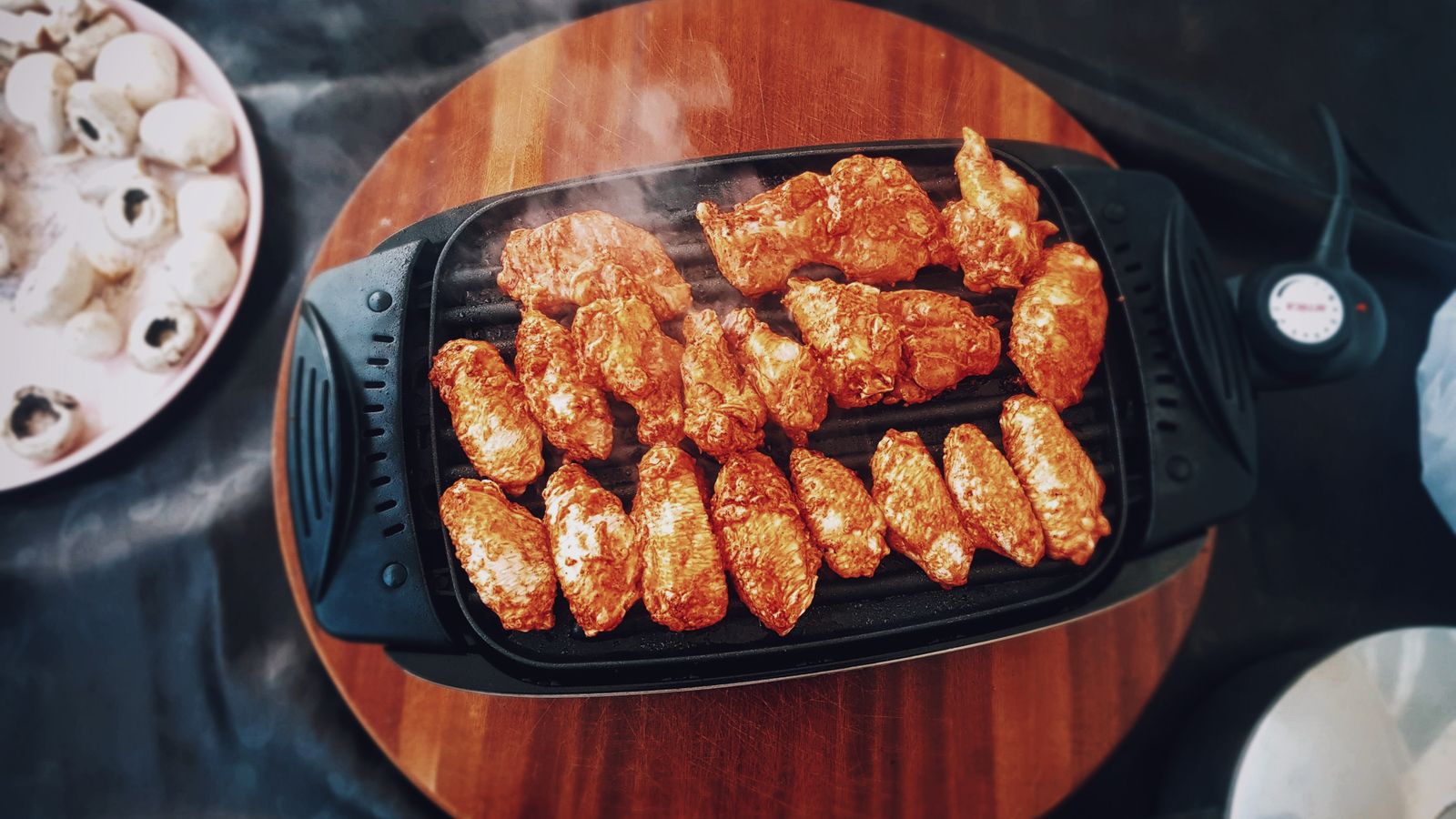
A single flat, ridged plate you cook on directly, similar to a griddle with raised ridges. These give you the most control over doneness since you flip food manually, and they’re often the easiest to clean.
Vertical Grills
Food hangs or sits upright near a heating element, letting fat drip straight down away from the food. Vertical grills are compact and excel at fattier cuts like bacon or sausage, but they have a smaller usable cooking area per session.
Griddle-Grill Combos
Some countertop grills include swappable or reversible plates, so one side grills while the other acts as a flat griddle for eggs, pancakes, or stir-fry style cooking. These add versatility if counter space is limited and you want fewer appliances overall.
Step 4: Check Size Against Your Actual Counter Space
Measure your available counter footprint before you shop, including clearance for the lid to open fully and space to set the grill down while it’s still hot. Many smokeless grills also generate heat and steam upward, so factor in cabinet clearance above the appliance too. If your countertop lineup already includes an air fryer, rotisserie oven, or coffee machine, sketch out where each one lives so you’re not buying a grill you’ll end up storing in a closet.
If storage is tight, prioritize models with a flat, low-profile lid, a folding or detachable handle, or a compact footprint under roughly 15 x 15 inches when closed.
Step 5: Weigh Wattage and Heat Performance
Wattage affects how quickly the grill preheats and how well it holds temperature once food is added. Lower-wattage grills (under 1,000 watts) tend to preheat slower and can struggle to maintain sear temperature with a full load of food. Mid-range grills (1,200-1,500 watts) generally offer a good balance of speed and even heating for most households. If you frequently cook for a crowd or want restaurant-style sear marks, look toward the higher end of that range or beyond.
Step 6: Prioritize Cleanup Features
Grilling produces more residue than most other countertop cooking methods, so cleanup ease genuinely affects how often you’ll reach for the appliance. Look for:
- Removable, dishwasher-safe grill plates
- A separate, easy-to-empty drip tray or water reservoir
- Nonstick coatings rated for metal-utensil use (or note if only silicone/wood tools are safe)
- A drip tray large enough to hold a full cooking session’s worth of fat without overflowing
Step 7: Compare Models Before You Buy
Once you know your size, format, and feature priorities, compare a handful of specific models side by side rather than picking the first one that matches on paper. A roundup of tested smokeless indoor grills is a useful starting point, since it lets you see how smoke control, plate size, and cleanup features actually perform across real cooking sessions rather than just spec sheets.
If you’re building out a broader countertop cooking lineup, it’s also worth thinking about how a smokeless grill complements appliances you already own or are considering, such as a rotisserie oven for slow-roasted mains or a countertop machine for morning coffee.
Common Mistakes to Avoid
- Buying based on “smokeless” branding alone. Check for an actual drip-tray design, fan, or water reservoir rather than trusting the name on the box.
- Ignoring plate material. Cast-aluminum nonstick plates tend to hold heat better and sear more evenly than thin stamped-steel plates.
- Underestimating storage space. A grill that’s too large to store easily will end up used less often, defeating the purpose of buying it.
- Skipping the drip tray after each use. Leftover grease left in the tray is the most common cause of unexpected smoke on later cooking sessions.
- Overcrowding the plate. Packing too much food on the grill traps steam and fat, which increases smoke and prevents proper searing.
Safety Notes
Always place a smokeless indoor grill on a heat-resistant surface with clearance on all sides, away from cabinets and curtains. Even “smokeless” models release some steam and heat upward, so avoid running one directly under a low cabinet without ventilation. Let the drip tray cool completely before removing it, and never use metal utensils on a nonstick plate unless the manufacturer specifically rates it for that use.
Frequently Asked Questions
Are smokeless indoor grills actually smoke-free?
No grill is 100 percent smoke-free, especially with fatty cuts of meat. “Smokeless” models significantly reduce smoke through drip management, water trays, or fans, but you may still notice a light haze with high-fat foods cooked at high heat.
Can I use a smokeless indoor grill instead of a rotisserie oven?
They serve different purposes. A smokeless grill is best for quick-cooking, sear-marked proteins and vegetables, while a rotisserie oven is better suited to slow, even roasting of whole cuts like chicken. Many households use both for different meals.
How much counter space do I need to reserve?
Plan for at least the grill’s closed footprint plus a few extra inches on each side for ventilation and lid clearance, along with a nearby spot to set the hot appliance down safely after cooking.
Do smokeless grills work well for searing steak?
Flat contact grills and open flat-plate models with high wattage and ridged plates can produce a solid sear, though they generally won’t replicate the intense char of an outdoor charcoal grill.
Final Thoughts
The right smokeless indoor grill for your countertop lineup comes down to matching real cooking habits – portion size, frequency, and the type of sear you want – against the grill’s smoke-control design, plate format, and footprint. Take the time to check wattage, cleanup features, and available counter space before buying, and compare a few tested models rather than choosing on branding alone. Done right, a smokeless grill becomes one of the most-used appliances in your countertop cooking lineup rather than one that gets pushed to the back of a cabinet.